
S†
Originally uploaded by a nameless yeast.
We quickly learned Winogrand's technique--he walked slowly or stood in the middle of pedestrian traffic as people went by. He shot prolifically. I watched him walk a short block and shoot an entire roll without breaking stride. As he reloaded, I asked him if he felt bad about missing pictures when he reloaded. 'No,' he replied, 'there are no pictures when I reload.' He was constantly looking around, and often would see a situation on the other side of a busy intersection. Ignoring traffic, he would run across the street to get the picture. Incredibly, people didn't react when he photographed them. It surprised me because Winogrand made no effort to hide the fact that he was standing in way, taking their pictures. Very few really noticed; no one seemed annoyed. Winogrand was caught up with the energy of his subjects, and was constantly smiling or nodding at people as he shot. It was as if his camera was secondary and his main purpose was to communicate and make quick but personal contact with people as they walked by. At the same time, as he passed from shadow into sunlight into shadow again, he was constantly adjusting his meterless camera. It was second nature to him. In fact, his first comment right out the door was, 'nice light--1/250 second at f/8.' I tried to mimic Winogrand's shooting technique. I went up to people, took their pictures, smiled, nodded, just like the master. Nobody complained; a few smiled back!via the flickr portrait group.

I was framing this building in my nikon n90 when it jammed (I still haven't mastered changing modes on the thing), and this gentleman happened into the picture. through the viewfinder, I saw him stop just to the right of this doorway,lean back and shrug. he was kind and patient enough to wait for me to switch to digital.
In a city where strange, discolored puddles appear in the streets and overflowing trash bags are placed in plain view, most New Yorkers accept the fact that the place will, at any given time, smell....
...But some residents have lately gotten a whiff of a different sort of scent. ...

I've been shooting more film lately, and in the rush to get it processed I've shot more than a few frames just for the sake of finishing off a roll. here are some of my end-of-roll pix, taken on the way to asman photo on capitol hill.
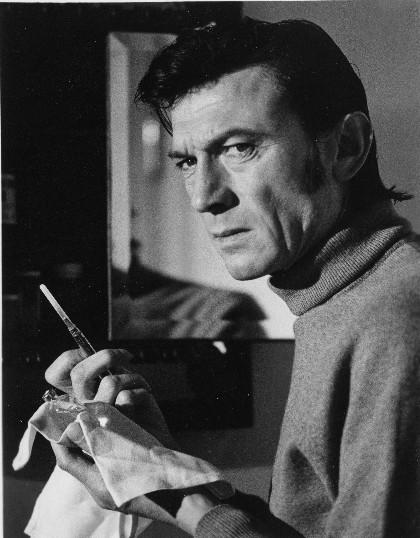 :..:::.::
a friend of a guy I know painted this, among other canvases derivative in a surprising variety of ways and means (not a few faux ernsts, for example). though between you and me, this sofa-sized tableau is a reproduction with added highlights. check out the incongruous picasso bull coming out of the left edge.

this gentleman, seen vutting a rug on georgia avenue, reminds me of the woman who used to get up in blue and red tights and dance with a two-liter bottle of rc cola balanced on her head. she plied her trade in the late '80's/early 90's at the tricorner median where constitution ave and pennsylvania ave meet. I never figured out if she was a shill or if she just really liked her rc cola. I took a picture of the rc cola woman at the taste of dc festival one year and I'll post that as soon as i can find it. in the meantime, this man may be looking for a corporate sponsor.
SPOILERS for PUNCH-DRUNK LOVE, PLAYTIME, and L'ECLISSE ...
Barry Egan is insulated. From his no-spill coffee mug to the massive rolls of bubble wrap that deck his warehouse walls to the (he hopes) unbreakable fungers he peddles. Yet the walls of his warehouse are exposed brick, andit is through this chink in the armor that Emily Watson finds him.
After she finds him, watch him take quick, nervous sips from the insulated vessel. But, when curiosity gets him and he steals away the harmonium, the vessel rattles atop the instrument, in danger of falling. But this thing he struggles with - what is it? He doesn't know, but it's worth something,if only for the struggle.
What is distant on the photographic plane becomes close. Barry to the harmonium. Lena to Barry. Barry with the harmonium to the warehouse. This optical distance works on the level of the emotional distance plied by the unlikely like minds of two directors in their key works: Jacques Tati's PLAYTIME and Michaelangelo Antonioni's L'ECLISSE.
In PLAYTIME, the distance between characters on the film plane is a joke. Hulot waits around the corner of a long hallway and hears an executive's footsteps sounding down the hall, intending to meet our hero. The footsteps grow louder - Hulot rises for a polite greeting, but the uniformed doorman waves him down, not yet. The dance repeats. These areunending footsteps. People are not as close as they appear.
Antonioni's signature emotional distance is supposedly reflected in affectless characters carrying out their banal lives in a grid of anonymous glass and concrete boxes. Tati uses this architecture to comic effect (ha ha, the same banal office box appears in travel posters for every country); people lose each other in reflections and cubicle farms. As Tati revels in the long shot, his Hulot is content merely to observe life. He is content to encounter people only by chance. He affects those around him, but is mostly unaffected by them. He never gets close to people - he never gets the girl. Antonioni's camera gets right in people's faces, which reveal an inner anguish and passion that they may not be able to express, but which visibly ache with their inarticulated needs. Imagine - you get close to people, and they turn out to be complicated! What a to-do! Comedy happens to other people; when it happens to you, things are not so strictly choreographed, the technicolor ballet of slapstick artgives way to the inconistencies and blemishes of life.
The closing sequence of PLAYTIME, in abstract, is frankly bleak: a woman opens a package from a stranger she'll never see again and finds a forget-me-not; cut to forget-me-not shaped streetlights, (these are among the few close-ups in the movie! objects!) which begin to illuminate at dusk; a longshot of the city lit at dusk autos and buildings still visible, then blam: nothing but abstract lights. Sure there's jaunty music, but imagine that music under the stunning final sequence of L'ECLISSE; with the issued dissonant, abstract music, it's a dissonant, abstract, bleak sequence. Try to imagine the end of L'ECLISSE with the music from the final sequence of PLAYTIME - it kind of works! So: is therejoy to be found in this banal modern world; or is there only loneliness?
PUNCH-DRUNK LOVE strikes me as a kind of bridge between the perfect labnotated dance - to be seen from a distance; and the unpredictable mess of improvisation that makes people up close people.
The first of Jeremy Blake's animated transitions is an overture to this: the perfect stripes, the rorshach in fuschia; the music underneath it expreses the tenor of the whole movie: the disonnant percussion, the harmonium, Shelly Duvall, Hawaiian guitars. It's allthere, diverging voices in beautiful imperfect unison.
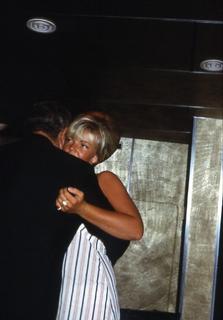
While some of the stuff was your typical amateur family stuff there was also some work that I think is extraordinary, work reminiscent of the 1960s photography of Gary Winogrand and Lee Friedlander- shots taken from behind the wheel of the car while driving across country, a series of photos of burning buildings, and two series of photos taken of TV screens- one of JFK's funeral, the other of RFK's funeral.via the boat lullabies

I have omitted the family name out of (grudging) respect for the living, and fear that the living may have ways of dealing with disrespect. Jack looks smashing, but does this mean Bessie is locked into eternity wearing that dress?
Mr. Peretz is a movie director, and Mr. Shaw is his chief assistant. Along with other filmmakers, they have been lured to New York by new film-friendly city policies, particularly lucrative tax incentives available to films and most television shows. But there's a twist. To gain the greatest benefits, filmmakers must shoot a certain portion of the movie in the city, even if big chunks of the script call for scenes set in places far away, and far different, from New York.

the back of this postcard reads,
"To George
Having a good time some roads
and scenery.
How is Skipper.
from Pop"

The site ["We're not afraid"] was created on July 7, the day of the bombings, when Alfie Dennen, who works at Stream UK in Chalk Farm, England, posted a picture of the London skyline with this caption: 'Show the world that we're not afraid of what happened to London today, and that the world is a better place without fear.' Since then, the sentiment has shifted somewhat....
...more and more, there's a brutish flaunting of wealth and leisure. Yesterday there were lots of pictures posted of smiling families at the beach and of people showing off their cars and vans. A picture from Italy shows a white sports car and comes with the caption: 'Afraid? Why should we be afraid?'"

from a must-see show at cheim and read. william eggleston set up a box camera with infrared film and took these shots at memphis bars. I tend not to think of him as either a portraitist (save the occasional coiled chain-smoking blonde) or in b&w, but these are gorgeous.


from the folklife festival, a Food Culture USA exhibit on eggs. you can buy this chart here
Interior Quality of Eggs (AMS-PY-004) (chart). Color photos illustrating quality factors that meet the specifications of the U.S. standards for quality of individual shell eggs with respect to the white and yolk. 15x22". 2001. $3.75 each.


