Monday, July 18, 2011

every camera i own: the olympus om-1

The Olympus OM-1 was my first real camera, a hand-me down from my brothers. I started using this one in the late 80's and continued to use it through the early 2000s. Before I began acquiring  cameras - which not coincidentally was around the time I joined flickr,  it was my only camera.

I've had it shelved for ages - the meter died twenty years ago even after repairs, and the shutter speeds seemed sluggish the last time I tried it. But after years hauling around the Nikon N90 as my go-to film SLR, I was surprised how light the OM-1 is. I'd forgotten how easy it is to carry around. I ran into Chris Chen aka furcafe, and although he's not an OM-1 owner he admires the compact size - not much bigger than a classic Leica rangefinder, he pointed out (as he frequently does, he had a Leica for comparison). Chris pointed out that the shutter-speed controls on the front of the camera, around the lens, strikes him as strange - most cameras have shutter speed controlled by a dial on top of the camera. But this is how I learned it.

The earliest OM-1 shot I can find on my flickr stream, the late Willem Breuker, ca. 1996:

RIP Willem Breuker


I loaded my OM-1 with Fuji 200 and expected the shutter speeds to result in a lot of overexposed shots. But the roll turned out alright. This old school corner shop is home to the Capital Bikeshare station I use. It also seems to be the only place on the Hill where I can find Pom juice.

every camera i own: the olympus om-1

Olie's Trollie downtown - the blown highlights may be due more to my not compensating than to slow shutter speeds:

every camera i own: the olympus om-1

Friday, July 15, 2011

the bloggy, bloggy movie review

More highlights from my weekly movie column for the DCist. Visit the DCist for this week's column, See this week's column, Popcorn & Candy: Manacled Mormons and Androgynous Aliens Edition, in which I review Tabloid, the new Errol Morris film. I also reviewed three offerings from the Capital Fringe Festival this week, my favorite being the Pointless Theatre Company's Super Spectacular Dada Adventures of Hugo Ball.

From Popcorn & Candy: Technology is a Blessing and a Curse Edition, June 30, 2011


Larry Crowne

What it is: The second feature from writer/director/auteur Tom Hanks, whose portrayal of the lowly worker is a stark rejoinder to the oppressive hegemony of the Roumanian New Wave.
Why you want to see it: The titular Crowne (everyman a King, yo) is called to the front office at the big-box store where he works, boasting to his cow-orker that he's won Employee of the Month designation an Ed Rooney-esque NINE TIMES. [Ed. note: I had (and still kind of have) no idea who Ed Rooney was when I wrote this, but my editor inserted the additional qualifier.] But this time Crowne is a different statistic: he's laid off, allegedly because he lacks a college degree. And thus, multi-millionaire Tom Hanks (who I'm sure is a nice guy) takes an imaginary bullet for The People. Oh the catharsis! Hanks wrote and directed -- his first such project since 1996's That Thing You Do, which painted a picture of stardom in a more innocent time. But is this the right time for innocence? Is Forrest Gump II going to make America sleep better through this economic crisis? No, but Hanks' studied naivete magically transforms this picture into a live-action Spongebob Squarepants, in which the forbidden sexual tension between Spongebob and Squidward (Julia Roberts) is finally, subversively fulfilled. Co-written by Nia Vardalos of My Big Fat Greek Wedding fame; exercise extreme caution.

View the trailer NINE TIMES.
Opens tomorrow at a pineapple under the sea near you.


Rear Window

What it is: The AFI's Hitchhock retrospective continues with one of his greatest films.
Why you want to see it: Photo-journalist L. B. Jeffries (Jimmy Stewart) is holed up in his Greenwich Village loft after breaking his leg shooting an auto race. (Be careful out there, kids!) Bored and restless, he watches the comings and goings of his neighbors across the way. Rear Window is one of the classic thrillers. But it is also a case study in the power of photography, and of seeing. The film's main action takes place entirely in the space of one character's apartment, and what he sees from his window: the courtyard, a distant street, fragments of his neighbor's apartments, framed by their own rear windows. Does this presage the internet? People-watching has long been a favored past-time, and with a lens trained on nearly everybody it's hard to know where to look. Can what we see hurt us? This masterpiece from fabled voyeur Alfred Hitchcock examines the dangerous nature of photography while celebrating it with finely-crafted suspense and one of the great screen beauties, Grace Kelly. A Bernard Hermann score [I only realized after I wrote this that Hermann would not begin to collaborate with Hitchcock until The Trouble with Harry] might have made this a perfect movie, but Franz Waxman's treacly music serves as a fluffy counterpoint to the brooding danger within. Trivia note: the score is performed on screen by a young Ross Bagdasarian, creator of The Chipmunks.

View the trailer.

----

From Popcorn & Candy: Young and Misunderstood Edition, July 7, 2011


Psycho

What it is: The birth of the shower scene.
Why you want to see it: Marion Crane (Janet Leigh) is an office drone entrusted with enough money to blow Phoenix for greener pastures. Too bad she has a change of heart -- at the Bates Motel. Hitchcock's beloved avian imagery -- both predator and prey -- explodes a few years later in The Birds, but here it plays a more subtly sinister role: flight is arrested and animal urges are kept in check by man's own cages. What is the shower but a birdbath, the carving knife our hunger for fresh KFC? Psycho is the ur-slasher movie, the iconic shower scene the first in a long line of brutal punishments that are visited upon any sexually active bodies with the misfortune to find themselves in a horror film. Its influence goes far beyond the theater, to music ("Psycho Killer"), art (Douglas Gordon's 24 Hour Psycho), and even the collector's doll market (the shower scene became a liimited edition Madame Alexander doll). And thus, the film itself is like a phoenix: out of the horrific crimes of Ed Gein (who inspired Robert Bloch's source novel) rose something like poetry. Or is it kitsch? For all its strengths, the movie is flawed, the psychological exegesis ridiculous, the plot twists so much a part of the collective consciousness that it is impossible to watch it with the intended suspense. Then again, seeing the film with an audience helped Hitchcock realize the movie was, in fact, a black comedy. It may not be as funny as, say, Eraserhead, but rather a stark look at the arid morality of the American desert, an Oedipal western with Perkins as a troubled outlaw. And mother? She's the sheriff.

View the trailer.

Tuesday, July 12, 2011

#photobook review: in almost every picture 10: pig, by Michael Campeau

Article first published as Book Review: In Almost Every Picture 10: Pig, by Michael Campeau on Blogcritics.

The tenth volume of the vernacular photography series In Almost every Picture, edited by Erik Kessels, is printed on a pretty pink stock. It’s nearly the color of the Financial Times, but rather than conveying fickle market trends, this tome sets in print a singular, enduring obsession.

When Michael Campeau gathered his family photographs nearly forty years ago, he noticed an unusual image from 1963. It was of his mother, bottle-feeding a piglet in the middle of Au Lutin Qui Bouffe (The Noshing Elf), a popular Montreal restaurant.

The success of a great many photo books goes beyond the quality of the photos themselves. Sequencing and book design - from layouts to paper stock - are all crucial parts of the puzzle. But it all starts with a concept. Campeau’s took shape by coincidence. In 2005, he worked with a friend who was gathering his own family photographs. Among those was a familiar image: in the same restaurant, another piglet was being bottle-fed by a customer.

The photographer placed an ad in local senior’s newspaper in search of similar photos, and his piglet obsession became a study in the piglet obesssion of others. In Almost Every Picture selects over a hundred such images commissioned by restaurant proprietor Joseph B. McAbbie from 1938 to 1973. McAbbie later hired “society photographer” Jean-Paul Cuerrier to make the photographs, which Cuerrier continued to do even after the owner’s death. Cuerrier’s son told Campeau that in a single night his father might take over two hundred and fifty photographs of feeding time.

The piglet and the decor are a constant, but multitudes are to be found in customers of varying ages and social background, from solo diners to couples, from a nun to a gathering of Shriners. Conflicting stories abound as to the fate of the piglets. By some accounts, the milk-fed pink delight grew up to feed elfin customers. But others tell a tale of long pig lives led on an idyllic farm. Au Lutin Qui Bouffe made thousands of piglet pictures, but many are lost. A fire closed down the Montreal landmark, and closed the door on the photo op memorialized In Almost Every Picture. We must rebuild.

Sunday, July 10, 2011

every camera i own: the gevaert rex junior

This week's camera with a kitty is a little late, owing to the usual film problems as well as a few other pieces that took priority. You can read my recent reviews of Running Drill at Transformer Gallery, and the Washington Shakespeare Company's production of Richard Foreman's Hotel Fuck, on the DCist.

The Rex Junior Gevaert is a bakelite toy camera with a collapsible lens that twists out for shooting and twists back in for compactness. It's similar in design to the German Pouva Start, although the Argentinian Junior began its commercial life in 1950, the year before the Pouva debuted.

The Rex Gevaert uses 620 film.  I bought it at the Feria de San Telmo in Buenos Aires, one of the world's great flea markets, and used the camera just once since then.


I don't remember having to tape up the frame window for that initial roll, which I shot in the cold light of winter. I really need to start taping these babies up, especially in summer heat. You can see the backing paper text cleanly burned through to the image, shot in New York last weekend.

flatiron-2

Nuts.

Friday, July 08, 2011

the motion picture show: highlights from my weekly movie column

Dick Dyszel as Mayor Wicker in The Alien Factor.
I've started writing the weekly Popcorn & Candy column, a roundup of the coming week's movies, for DCist. It's at once my most visible gig (who doesn't check movie listings?) and my most ephemeral (who's going to look up what I wrote about a video screening of Night Patrol?). For some reason this column stresses me out more than anything else I write, and perhaps I end up overwriting now and then to compensate.  I'll occasionally highlight some of my P&C blurbs here.


--


From my first column, Popcorn & Candy: Criss-cross Edition May 26, 2011. You can see from the url that I originally planned to use the subtitle "Why is My Body Changing? Edition," but I shelved that for the following week.

The Hangover Part II
What it is: The start of summer movie season.
Why you want to see it: Drunken blackouts are a primitive form of teleportation. One minute you're tossing back a wine cooler and then BLAM: you wake up in a strange room with a chicken from an advanced civilization that visits hotels in search for human blood. The first Hangover took this bacchanal as a jumping off point for fraternal hilarity and even something that approached human feelings. Director Todd Phillips' sequel ups (or downs, considering on your perspective) the ante with a scenario in which our favorite drinking buddies are teleported to Bangkok.
What to expect: Culturally insensitive hijinks.
What not to expect: A cameo by Mel Gibson, which was scrapped after his very public breakdown last fall. Maybe he should have pulled out The Beaver?


Opens tomorrow within projectile vomiting distance.


--


White Irish Drinkers. As a commenter pointed out,
this is supposed to be 1970s Brooklyn?
From Popcorn & Candy: Why is My Body Changing Edition, June 2, 2011.

White Irish Drinkers
What is it: A tale of working-class Brooklyn circa 1975.
Why you want to see it: The words, "from the creator of The Ghost Whisperer" send this movie columnist into a cold sweat, but as long as Jennifer Love Hewitt doesn't show up cooing to her carrier-pigeons with a fake brogue, I will try to reserve judgement. Writer-director John Gray cut his teeth making 8mm films in his Brooklyn neighborhood, to which he pays homage with this story of coming of age among alcoholics, mobsters, and The Rolling Stones. Does this melodramatic return to the borough of his birth mean a return to low-budget roots? Or has he never really recovered from that Jennifer Love Hewitt dream sequence with a white tiger?
What to expect: Highly coached Brooklyn accents.
What not to expect: Vajazzle
.


--

Euro-Asia Shorts 2011
What it is: A festival of short films from around the globe.

Why you want to see it: Young couples, cantankerous elders, a planet where women are macho and men weak, and a clown that can't make people laugh are just some of the subjects on tap in this sprawling survey. "Five nights. Nine countries. One Theme" -- the last being Men and Women -- is the focus here. How that relates to Cuore di Clown (Clown Heart), (Tuesday, June 7th at the Japan Center on 18th Street) is anyone's guess, but it will only take 14 minutes of your time to find out.
What to expect: Where clown hearts beat, clown tears surely fall.
What not to expect: God willing, Jennifer Love Hewitt.

--


From Popcorn & Candy: You Are Tearing Me Apart Live Edition, June 9, 2011.


The Room Live
What it is: Tommy Wiseau and Greg Sestero appear in a live adaptation of what some call The Worst Movie Ever Made.
Why you want to see it: Cult hit The Room is not by any measure a Good Movie. But it's a Great Bad Movie. Tomorrow night, the AFI Silver presents auteur Tommy Wiseau in a challenging new medium: live theater. The Room Live promises your favorite scenes as well as new scenes from everyone's favorite possibly Louisianan filmmaker. Will it be a train wreck or a revelation? I'm hoping for the latter, and here's why. What sets The Room apart from your typical midnight cult classic is Wiseau's complete lack of irony. Tommy -- as his fans intimately call him -- never winks at the viewer as if he's letting them in on a joke. He's completely earnest, and completely, heroically himself, despite a nation recoiling in horror at The Room's love scenes. And as strange and silly as his vision may be, he's true to his own star. Tommy's first new work since The Room was last year's short The House That Drips Blood on Alex, and he was the best thing about it. Sadly, he didn't write the self-conscious, knowing script -- you could practically hear the air quotes around any dialogue not spoken by its star. More successful is the recent short video series Tommy Explains it All (assaying, so far, Citizen Kane and Love) which makes the right decision to just let Tommy talk and let the magic happen. And if you go early enough, you can make a double bill of unparallelled aesthetic contrast with our next featured pick. [Diary of a Country Priest, which I saw right before The Room Live with no measurable aesthetic damage to either.]
What to expect: God to forgive you.
What not to expect: To be torn apart.

Read my full review of The Room Live here.

 --


From Popcorn & Candy: Music and Martians Edition, June 16, 2011.


The Stuff
What it is: Schlockmeister Larry Cohen's prescient satire of consumerism.

Why you want to see it: "Pre-swhu-huh?" you may ask. Cohen made his mark with the mutant homicidal baby series It's Alive. Horror movies are often manifestations of deep societal anxieties -- sexual hysteria in vampire movies, mindless consumerism in zombie pictures, growing pains in I Was a Teenage Werewolf, clothing manufacturer's inconsistent sizing practices in Sisterhood of the Traveling Pants. Thus the intelligent B-movie is no oxymoron, and The Stuff is enjoyable, thoughful and just well-acted enough to put the lie to the notion that Psychotronic necessarily equals "bad." A natural fount of bubbling sweet white stuff is found in Alaska and marketed as a dessert. But is the stuff...alive? Michael Moriarty (whose aw-shucks with a hint of menace would have made him perfect for The Killer Inside Me) investigates the titular material's mysterious contents for a rival company, only to find himself face-first in it. Could this satirical story of the killer inside us have foretold 21st century cupcake mania? You will eat a cupcake. You will eat a cupcake.
What to expect: Better acting than you'd think.
What not to expect: To leave The Passenger not yearning for a cupcake.

Wednesday, July 06, 2011

#photobook review: More Cooning with Cooners, edited by Kalev Ericson

Article first published as Book Review: More Cooning with Cooners, edited by Kalev Ericson on Blogcritics.

In the last few years, the independent UK publisher Archive of Modern Conflict has released a fine streak of photobooks, from their handsome collection of Kodachromes, The Corinthians; to Larry Towell’s exquisite variation on the family album, The World from my Front Porch; to Nein, Onkel, a collection of snapshots that supposedly gives us a look at the more "fun-loving" side of Nazi Germany. The Kodachromes of More Cooning with Cooners may at first glance seem a more focused sequel to The Corinthians. But the second glance is telling.

The discomfort with which I type or even shorten the title is the first sign that this is not your ordinary collection of vernacular photography. The title is based on a 1924 book called Cooning with Cooners, on the culture of Ohio raccoon hunters. The phrase is seen early in the present book, emblazoned on a trailer hitched to a station wagon in front of which one proud hunter poses with this hound. The photographs gathered here were made by one such hunter who worked through the 1960s, which places it in a context in which the changing world outside them seems to have had little effect on their language and bloodlust. It is a cruel tease that the book opens with a photograph of two playfully alive raccoons, for the rest of the book documents the plundering of the animals (if not, as the accompanying essay points out, to their extinction, as the buffalo), and the dogs and men who hunt them for their pelts.

What the photos lack in sharpness and technical prowess (flash lights glow from racoon, hound, and human eye alike), they make up for in cumulative power: this is what hunting looks like, from suiting up, to dog prep, to the chase, to the kill, to the season’s total. The fact that a 1924 poem called “Dat Scanlus Coonhunt Itch” is used to place the photos in historical context increases the unease, but it is almost overkill - the spirit of the times may not be spelled out in the photos, but you can see between the lines well enough.

The book's endpapers indicate the dramatic arch of the photographs, with an illustration of a raccoon head inside the front boards and a raccoon skull inside the back boards. The accompanying essay does not judge these men who pose with rows and rows of pelts, but posits these photos as the document of a lost subculture. I’m no card-carrying member of PETA, but it’s hard not to look at these images of good old boys with guns and shudder a little. Maybe I’m just a city boy who doesn’t want to know what’s going into his hot dogs. More Cooning with Cooners is a smartly designed book whose selection and sequencing leads the reader places you may not expect to go. It may enchant you. It may disturb you. Sounds like a great photobook to me.

Consumer note: the book is limited to 500 copies, and is already fetching a premium at Amazon. The curious will do better to look for this at places like Dashwood Books or Photo-Eye, or directly from the publisher, who offers a special edition with a photo print and an original copy of the 1924 book, enclosed in a raccoon fur slipcase.

Thursday, June 30, 2011

every camera I own: the blackbird, fly 35mm twin-lens reflex (orange)

Market strategy for the Blackbird, Fly (yes, its name has a comma; yes, that's awfully precious) would have you believe that "many TLRs are hundreds of dollars," which I guess is true if you want a Rolleiflex. But you can easily get, say, a Yashica A (or two!) on eBay for less than the Franklin and change that this camera, comma, will set you back.

And yet when I saw one at the ICP Store, long before they'd turn up at Urban Outfitters, I grabbed it. After all, it was in my favorite color. It's a cute little plastic bastard, and comes elaborately packaged in a hip cardboard box with a hip plastic bell enclosing it like hip pheasant comma under glass. Really comma I hadn't noticed that affected comma before comma but it is certainly the kind of minute annoyance upon which one can become fixated comma isn't it.

I loaded it for the very first time about a week ago, nearly three years after it was introduced.

The Blackbird Comma Fly is modelled after the classic Twin Lens Reflex design, but takes 35mm film which you can use in three different formats: with a square or rectangular mask, or without the mask, which is supposed to let the image bleed onto the film sprockets for a larger square negative. I shot a roll of expired Kodak "High Definition" 400 that I acquired from some Flickr group that was handing out expired film, some of it crappy (what I loaded the B,F with), but some of it pretty good - varieties of Kodak's VC and NC (Vivid Color and Natural Color)  Portra stocks.

I shot the B,F without a mask because I am photographically  naked like that, but the Walgreen's where I have been taking my disposable and toy 35mm pictures for developing printed them oblongatic anyway.

I thought 400 ASA film would be too fast for the camaera and I'd end up with blown highlights, but the lens specs beg to differ: a 1/125 shutter speed and an f7 or f11 aperture (never could move the lever that changes them) left me underexposed   on an overcast day:

Loews parking lot, Front Royal, VA.

I often forget that toy cameras have setting for normal exposure and bulb exposure - the former of which has a normal shutter speed (1/125 sec. in this case), the latter of which holds the shutter open as long as the shutter release is pressed.  I have a few very blurry pictures of my nephew as testament.

An under-exposed but not blurry photo of my nephew.

I was excited to see how these pictures would turn out, and so in full "let's finish off the roll on random stuff near the photo lab," I burned nine frames at and around Walgreens.


It is perhaps not a story for the ages, but it is my story.

Monday, June 27, 2011

better than a million Step Up 3s: NY Export Opus Jazz

A bonus review this week. Article first published as DVD Review: NY Export: Opus Jazz on Blogcritics.

NY Export: Opus Jazz proudly announces itself as the first film conceived, created, produced and danced by the New York City Ballet. But the film’s directors have some creative cachet as well. Co-directors Henry Joost and Jody Lee Lipes came fresh from very different projects: Joost was part of the team that brought you the controversial Catfish (his co-director and co-star of that film, Ariel Schulman, is production designer here), and Lipes made the fascinating documentary Good Times Will Never be the Same, about controversial artist Brock Enright. Whatever you think of those films, Opus Jazz may not be what you expect.

Jane Jacobs wrote of the city as an “intricate ballet, in which the individual dancers and ensembles all have distinctive parts which miraculously reinforce each other and compose an orderly whole.” The work of choreographer Jerome Robbins could be seen as a stylish embodiment of that romantic ideal. Robbins’ NY Export: Opus Jazz was envisioned as a companion piece to his work in West Side Story, and the paralells are clear in the kind of gangland tension and young sexuality, lines both flowing and staccato.
Lipes’ Good Times proved the cinematographer-turned director’s gift for the casual detail, carefully composed but still intimate and organic. His camerawork throughout is as impressive as you’d expect from the Brock Enright film, expansive or contemplative when needed, with a few stagelight lens flares thrown in for a sparing touch of the spotlight. The wide-angle lens used for most of the dance sequences give the performers room to breathe, and don’t make the mistake that dance films sometimes do of cutting away too much from the performers bodies. The aspect ratio is so wide that the film would be wonderful to see on a big movie screen.

The film was shot in various locations in New York, from old-school diners to the McCarren Park Pool to a stretch of the High Line before it was cleared, when it was more of a wild park than the manicured lawn it is now. The music by Robert Prince is full of youthful, brassy outbursts, and the young performers of the New York City Ballet are a joy to watch. Now if somebody can do this with Charles Mingus’ The Black Saint and the Sinner Lady, perhaps live in an abandoned warehouse, I promise full Stendahl Syndrome overload.

A featurette included with the DVD traces the history of this “ballet in sneakers” from its performance on the Ed Sullivan Show to its revival for a modern audience. If you love dance, jazz, and New York - or even if you only love two of the three - this is a must-see. And if you’re anywhere near a screening - the film is still making its way through the festival circuit - I envy you.

Sunday, June 26, 2011

photobook review: ed van der elsken, love on the left bank

Article first published as Book Review: Love on the Left Bank by Ed van der Elsken on Blogcritics.

Publishers have responded to the demand for collectible photobooks in a variety of ways. Errata Editions reissues highly valued titles, but resizes them to fit a uniform template. Not that I don't want the whole collection. The reissue efforts of Dewi Lewis Publishing may not have the depths of the growing Errata catalog (up to a dozen and counting in the Books on Books series), but they have created magnifiicent facsimiles of a number of classic photo books, from William Klein’s New York (its reissue now out-of-print and collectible) to Martin Parr’s The Last Resort (reviewed here last month), to this week’s title.

Dutch photographer Edward van Elsken published over 20 photobooks in his lifetime. His 1956 classic Love on the Left Bank is a fine example of the photobook as visual literature, for in spirit and texture it comes off as a marriage between Kerouac’s On the Road and Robert Frank’s The Americans (separate if related works - advantage Frank).

This fictionalized book-length photo essay follows the ill-fated love affair of a Mexican hitchhiker with a woman of Paris named Ann against the backdrop of a Left Bank that was then one of the great epicenters of art and culture. High-contrast, grainy black and white film captures the excitement and energy of youth and the city, and the varied page layouts keep the narrative moving. Spreads of jagged smaller panels feature plenty of white space, and Parisian shop-fronts that look as if they were made by an Atget who didn’t have time to stop and dream. These alternate with full-bleed two-page closeups of lovers and other strangers. The images are at once historical and timeless, though some of the Gill Sans-laid text has dated, with exchanges like, “You dance like an African negress” answered by “I’d like to have a child by a negro.”


“Ann” was actually Australian-born dancer/artist Vali Myers, who moved to Paris in 1949 and lived at New York’s infamous Chelsea hotel for a while - a few of her paintings in fact still adorn the hotel's storied walls. Myers’ drawings are featured throughout the book as well. If Woody Allen’s Midnight in Paris transports you to the Paris of the twenties, then the gritty photos and rhythmic page layouts of Love on the Left Bank will transport you to 1956.

Friday, June 24, 2011

every camera I own: the diana mini

The Diana Mini is based on a classic plastic camera design from the 1960s. The Diana and her many variations took 120 sized film,  and were/are not known for build quality - and that includes the Lomo "reissue." The revamped, rainbow Diana line included a limited edition red-and-white Meg White Diana set which I didn't expect to win on eBay. In 2009 Lomo introduced a Diana that used 35mm film - a smaller package than the medium-format Diana+ that of course cost twenty percent more and was no less a flimsy maiden who needed protein.  Maybe she is fragile because she is hunted. I could write about her as if she were a pony: I didn't think it would take long before I broke her. And it didn't. Before we sailed over the second hurdle etc etc glue factory. But she had true grit after all.

What happened was the shutter release at the side of the lens lost its shiny knob just before I loaded it for this project. And by "lost" I mean "it broke off when I tested it."

With a 24mm lens, it's a wider angle than most toy cameras. I've only used it once before, and apparently it leaked a lot:

Some kind of expired 400 ASA (probably too fast for it) Kodak stock. Malcolm X Park, Washington, DC.

Last week I loaded it with fresh Fuji 200. You can't tell in the above picture, but throw this 24mm lens some straight lines, and it throws back barrel distortion:

69950019


And, on occasion, frame advance issues:

69950014


Crappy scans courtesy of Walgreen's, where the film pick-up bins are never full.

69950015

Monday, June 20, 2011

photobook review: paul graham, beyond caring (books on books)

Article first published as Book Review: Beyond Caring (Books on Books) by Paul Graham on Blogcritics.

Paul Graham’s 1986 photobook Beyond Caring was made with the same instrument - the Plaubel Makina 6X7 - Martin Parr used for his photobook The Last Resort, originally released in the same year and reviewed here a few weeks ago. But the results could not be further apart.

Both trained an eye on Thatcher England, but while Parr found the lively and garish color in the middle-class on vacation, Graham paints a much darker, and perhaps more accurate picture of the state of the nation. In 1985 and 1986, Graham visited Social Security offices throughout England. He applied for permission from the DHSS, but was denied; so he surreptitiously made pictures without looking through the viewfinder - propping the camera on chairs or floors, holding it at waist level. The resulting compositions - skewed, voyeuristic - reflect a life out of balance. The Plaubel-Makina is a rangefinder and thus does not make the conspicuous ka-chunk of an SLR, so his subjects are unaware of and unaffected by his presence. What they are affected by is the tedium and desperation of bleak and sometimes filthy government offices, usually crowded and understaffed, where waits could last up to three hours and the payoff could be zero.

Graham came out of a school of New Color photographers in Britain, of which Parr is the most famous. But Graham’s eye is more socially conscious than his contemporaries’. Errata Editions reissued this book in their standard format - a facsimile that reproduces page layouts of the published tome. A frequent complaint made about this strategy is that the pictures lose some impact - more than usual in the case of Beyond Caring, a landscape-oriented paperback reissued as a portrait-landscape hardback. But Errata is to be lauded for making rare photobooks available for a fraction of their cost on the collectors’ market (originals of Beyond Caring go for $900!), developing an affordable library of classic and contemporary photography.
Thursday, June 16, 2011

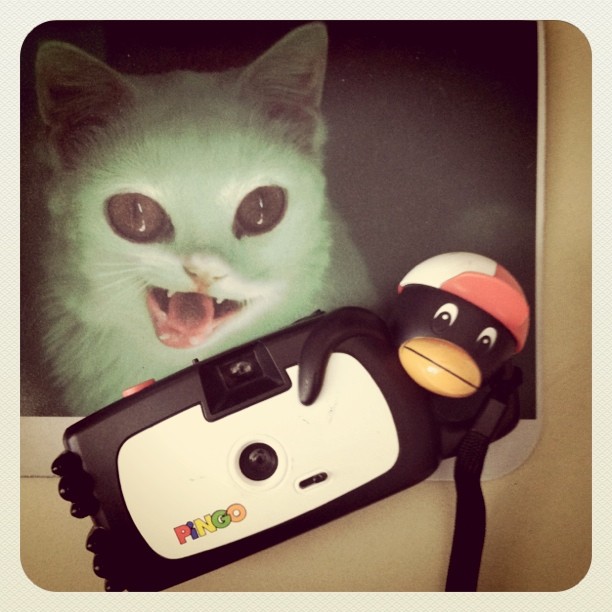
every camera i own: pingo

This post is not brought to you by Mr. Popper's Penguins, coincidentally in theaters now.

I don't remember how I found Pingo, only that I got him on eBay. He's your basic point-and-shoot 35mm plastic camera, with a little lever on his belly that slides a protective shield over the lens when not in use. I don't know why you'd need to protect the lens, but whatever.

I recently took a picture of a friend who asked me why I was taking his picture with a blackface jockey. I'd never made the connection before but Pingo has a cap and everything. Who knew?

As a photographic instrument, Pingo has no distinctive characteristics. But, he's a penguin.  And he's also the first camera with which I captured something that in some circles can be interpreted as ghost like:


I wrote about the incident on my ghost blog. I've long neglected my ghost blog, but it's not for lack of stories. My niece has been asking for more ghost stories so I'll try to come up with something soon. Anyway, because of the streaks of what resemble classic "ghost" images of ectoplasm, I've brough Pingo to reportedly haunted places to see if he can conjure up spirits. He hasn't yet. Before dusting him off for this project, I'd last used him in another haunted spot in Florida, the old Spring Hill Cemetery, which I wrote about here.

111950-R1-13


Pingo was having frame advance issues on this occasion, but the fresh roll of film I loaded him with last week came off without a hitch. Even though I took it to a supposedly haunted building.

68700017


My niece - the one who asked for more ghost stories - is trying to overcome her fear of ghosts. She has been known to shudder at the very mention of the g-word, but I've also known seen her watching one of the Harry Potter movies, and, when the soul-sucking dementors appear, I caught her cracking a smile.

The first haunted place I could think of that would be open on a Sunday was the Old Stone House in Georgetown, but that wasn't very convenient for our plans. My sister-in-law suggested the National Building Museum, formerly the Pension Building, which I'd forgotten about - I'd even taken a ghost tour, hosted by a fictionalized Mary Surratt. The former Surratt  boarding house is a few blocks away, and its former proprietor reportedly haunts the sushi place that currently occupies the space.

Anyway, there are stories of spectral faces appearing between the former Pension Building's majestic columns, and even a  haunting by Buffalo Bill Cody. But we didn't see anything, and my niece, who took pictures hoping to capture something spooky, was sorely disappointed.

68700007


Then we found ourselves in an office area that I'd remembered from the tour. The suite once housed the offices of the Pension Commissioner, one of whom, James Tanner, reportedly haunts the building.

The space felt strange to me - I kept feeling like somebody was behind me. But my pictures didn't reveal anything out of the ordinary.