This latest installment in a series of Cryptozoological Hits of the Seventies is, save for the lurid sleeve design, uninspiring product. Can any band of supposedly comic artistes be worth their salt as improvisors if they can't think of anything better to call their group than "The Improvisors"? The B-side is a Christmas record, and while they certainly deserved their share of Christmas pudding I'm certain nobody slipped a Muse in their stockings.
Monday, July 20, 2009


Friday, July 17, 2009
how to learn Dutch from movie titles - part 2
More from the book Filmtitels maken by A. Ph. Sterken (Focus, 1950).


Wednesday, July 15, 2009
the settlers - nessie the monster
By request: more cryptozoological hits from the 70's, this one from across the pond. The trick ending is a metaphor for the monster itself. Finally, who is the monster? We are the monster. Leave it to a handful of folk-rocking Europeans to ask the tough questions about life in the loch.
the revolution is still boring
DVD Review: A Grin Without a Cat and Inquiring Nuns
by Pat Padua
Director Chris Marker is best known for his masterpiece La Jetee, a 22-minute film consisting almost entirely of still images. This meditation on time and memory, which inspired Terry Gilliam's Twelve Monkeys, is one of the very few fiction films in Marker'svast oeuvre. (Less known is the music video he directed for Electronic's "Getting Away With It," which pays homage to La Jetee in its brooding remembrance of things past).
Marker's primary work has been in the documentary genre - but not the documentary as practiced by Ken Burns or even Errol Morris. Rather, Marker is a film essayist. Where La Jetee masterfully edited and juxtaposed the elements of still photographs to fashion a chilling science fiction, his documentary work, at its best, works such magic on the historical and cultural detritus of celluloid. His Sans Soleil (available on an essential Criterion DVD with La Jetee) is the pinnacle of this form, with layers of image and narrative that transcend the ordinary documentary to create a multi-faceted dreamscape of fact.
There may not be a more thorough document of the international student uprisings of 1968 than Marker's A Grin Without a Cat (aka Le Fond de L'air est Rouge). The director/essayist weaves a celluloid tapestry juxtaposing footage of explosives instruction with a television ad where an elderly couple boasts, "Now we're a TWO-set family." Copious tinted stock footage of army training films, pilot's-eye footage of a napalm attack on a village in Vietnam, and of course Eisenstein's The Battleship Potemkin battle for semiotic significance. But the talking heads (which include the likes of Che Guevara and Fidel Castro, natch) and onslaught of revolutionaries fail to incite the fervor of this non-student of the revolution. For the large part (Grin originally ran at what Marker himself admits was a megalomaniacal four hours) the released print is merely three hours) the film lacks the cross-disciplinary layering that makes Sans Soleil so fascinating. While essential classroom viewing, A Grin Without A Cat probably won't interest many outside the academy. But for those who were there in 1968, there's probably plenty of fodder for both sides of the political spectrum.
Inquiring Nuns sounds like a good concept for a half-hour television special: set two young nuns loose on the streets of Chicago asking passersby, "Are you happy?" The problem is that despite the seeming cross-section of the 1968 Chicago zeitgeist - both the hippies and the straight-laced, the religious and the non-believers - there's something about two young nuns asking "Are you happy" that prevents the interviewee from saying anything truly interesting. The respondents who the sisters speak to outside church - fresh after Sunday mass, even - are particularly polite and predictable. Which is too bad, because most of the people they speak to look interesting—you wonder what did the blue-collar worker, the businessman, the African-American grandmother, really think about what was going on in 1968? Many responded that they would be happier if America pulled out of Vietnam but that is all they have to say on the matter.
An occasional score by Philip Glass lends some minor chords to the proceedings but that's the extent of the tension onscreen. More interesting is the bonus material. Interviews with the nuns today reveal that both of them left the order, inspired by the times and each other to question authority (but not their faith) and pave a path that certainly contained more drama than the two television episodes on this DVD.
by Pat Padua
Director Chris Marker is best known for his masterpiece La Jetee, a 22-minute film consisting almost entirely of still images. This meditation on time and memory, which inspired Terry Gilliam's Twelve Monkeys, is one of the very few fiction films in Marker's
Marker's primary work has been in the documentary genre - but not the documentary as practiced by Ken Burns or even Errol Morris. Rather, Marker is a film essayist. Where La Jetee masterfully edited and juxtaposed the elements of still photographs to fashion a chilling science fiction, his documentary work, at its best, works such magic on the historical and cultural detritus of celluloid. His Sans Soleil (available on an essential Criterion DVD with La Jetee) is the pinnacle of this form, with layers of image and narrative that transcend the ordinary documentary to create a multi-faceted dreamscape of fact.
There may not be a more thorough document of the international student uprisings of 1968 than Marker's A Grin Without a Cat (aka Le Fond de L'air est Rouge). The director/essayist weaves a celluloid tapestry juxtaposing footage of explosives instruction with a television ad where an elderly couple boasts, "Now we're a TWO-set family." Copious tinted stock footage of army training films, pilot's-eye footage of a napalm attack on a village in Vietnam, and of course Eisenstein's The Battleship Potemkin battle for semiotic significance. But the talking heads (which include the likes of Che Guevara and Fidel Castro, natch) and onslaught of revolutionaries fail to incite the fervor of this non-student of the revolution. For the large part (Grin originally ran at what Marker himself admits was a megalomaniacal four hours) the released print is merely three hours) the film lacks the cross-disciplinary layering that makes Sans Soleil so fascinating. While essential classroom viewing, A Grin Without A Cat probably won't interest many outside the academy. But for those who were there in 1968, there's probably plenty of fodder for both sides of the political spectrum.
Inquiring Nuns sounds like a good concept for a half-hour television special: set two young nuns loose on the streets of Chicago asking passersby, "Are you happy?" The problem is that despite the seeming cross-section of the 1968 Chicago zeitgeist - both the hippies and the straight-laced, the religious and the non-believers - there's something about two young nuns asking "Are you happy" that prevents the interviewee from saying anything truly interesting. The respondents who the sisters speak to outside church - fresh after Sunday mass, even - are particularly polite and predictable. Which is too bad, because most of the people they speak to look interesting—you wonder what did the blue-collar worker, the businessman, the African-American grandmother, really think about what was going on in 1968? Many responded that they would be happier if America pulled out of Vietnam but that is all they have to say on the matter.
An occasional score by Philip Glass lends some minor chords to the proceedings but that's the extent of the tension onscreen. More interesting is the bonus material. Interviews with the nuns today reveal that both of them left the order, inspired by the times and each other to question authority (but not their faith) and pave a path that certainly contained more drama than the two television episodes on this DVD.
Tuesday, July 14, 2009
russian vernacular photos
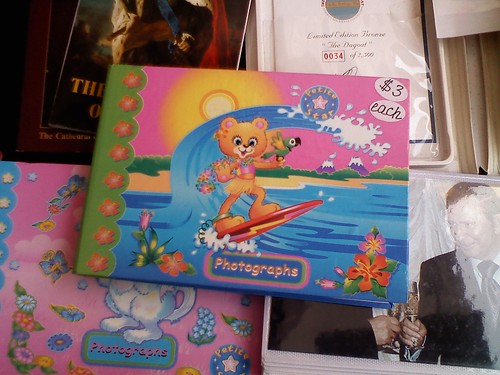
Ever since the bulk of outdoor flea markets in Chelsea moved to Hell's Kitchen, I've restricted most of my browsing to the Antiques Garage. I've ignored the few smaller markets left in the neighborhood, assuming they were closer in spirit to the kind of flea market whose specialties get no more obscure than knock-off designer purses and cheap socks and bootleg dvds. But I was wrong. One day this spring I stopped at one of those weekend parking lot markets that I normally pass by. I found the usual ratio of wheat and chaff but also some genuine antiques action. I was lured into one booth by a plastic photo album that depicted a surfing teddy bear. When I opened up that talismatic plastic ersatz Hawaiiana I was rewarded with a small but remarkable stash of Russian portraits and snapshots. Comrades of all inclinations as well as mail-order bride shoppers will find plenty here to whet the apetite:





Finding Beauty In A Broken World: In the Spirit of Frida Kahlo

The fabulous Veronica Ebert, aka lapinfille, is showing two of her pieces in this show curated by artist and art critic Lenny Campello:
Frida Kahlo inspired show opens
The Joan Hisaoka Healing Arts Gallery at Smith Farm Center in Washington, DC will be hosting Finding Beauty In A Broken World: In the Spirit of Frida Kahlo.
This exhibition showcases the work in all mediums of artists selected by me and whose work is influenced not only by Kahlo’s art, but also by her biography, her thoughts, and her writing or any other aspect in the life and presence of this powerful artist.
Frida Kahlo's artistic footprint in 21st century artists from all over.
This is the third Kahlo show that I have juried in the last decade and I am floored by the range of work and interpretations that I selected.
How to learn Dutch from movie titles
The first in a series of posts taken from the book Filmtitels maken by A. Ph. Sterken (Focus, 1950).

"Hein will be washing."

"Please, we have plenty in the freezer."

"I can see your house from here."

"Hein will be washing."

"Please, we have plenty in the freezer."

"I can see your house from here."
Monday, July 13, 2009

Sunday, July 12, 2009
Friday, July 10, 2009
little reese and little paul
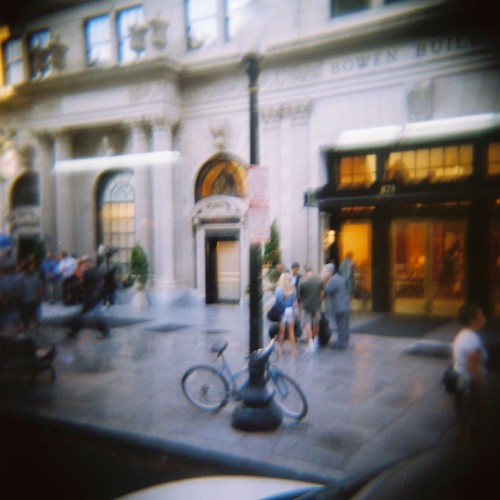
Reese Witherspoon and Paul Rudd were shooting a filum in town a few weeks ago, and they kept following me, first to the 18th and Columbia Rd. Starbucks. The next day they ambushed me while the 36 bus was caught in traffic on 15th street. Luckily, the bus sped me away unharmed.
Thursday, July 09, 2009
Art Review (NYC): Jonny Fenix at Leo Kesting Gallery - Blogcritics Culture
Art Review (NYC): Jonny Fenix at Leo Kesting Gallery - Blogcritics Culture
[I promise not to blog about Michael Jackson this week anymore. - ed.]

[I promise not to blog about Michael Jackson this week anymore. - ed.]
The art and design world's response to Michael Jackson's passing has been fast and furious – and in some cases prescient. Within days, sidewalk vendors in major cities were peddling King of Pop memorial t-shirts, some of them festooned with variations on Shepard Fairey's ubiquitous red, white, and blue Obama design, the caption HOPE sadly replaced with POP but not yet, as far as this reporter has seen, the plainly accurate DEAD.
As for the prescience, the Leo Kesting Gallery in the Meatpacking District was hosting an exhibition of paintings by artist Jonny Fenix when the King of Pop suddenly shuffled off. The gallery quickly erected an impromptu memorial, showcasing Fenix's work, "Michael's Jacksons", priced to sell at only $3,000. I shot a photograph of this display on fast, grainy film that had expired in the 1990's, imagining that the color cast would reveal something about the fickle finger of fame and the half-life of celebrity. As it turns out, the colors were fairly accurate. Chalk one up to enduring legends or, rather, to refrigeration as metaphor and preservation technique.
Gallery director David Kesting, who opened his space in 2003 as a showcase for "cutting-edge" artists, writes that "Fenix's visual library references the characteristics Americans love while subtly pushing us towards resolution of the negligent hypocrisy we are now becoming aware of." Among the other subtle canvasses decking these Meatpacking District walls are a hairy disembodied penis and a black Jesus flipping the viewer double-barreled fingers. Fenix knows how to get your attention, and his at times tabloid subject matter is presented with a keen design sense.
The exhibit closed on July 5th but its memory may linger in the hearts of pop-culture students and jaded gallery crawlers, while the rest of us will revel in the harder-earned but still morbid laughter evoked by the James Ensor show at MOMA.
Wednesday, July 08, 2009
meta-grief and the celebrity mourner

"I just don't believe that Michael would want me to share my grief with millions of others. How I feel is between us. Not a public event."
--Dame Elizabeth Taylor to her 80,000 followers on Twitter, explaining why she turned down a request to speak at the Staples Center memorial.
I don't think there's a *wrong* way to express personal grief. I've seen my share of hospital waiting rooms and funeral homes, and people deal with things the best they can, whether they gnash their teeth or find distraction or simply withdraw. The death of Michael Jackson is a huge media event, but it has also provided an outlet, and for many people a public outlet, for all the ways we grieve. Missing the music and lamenting its decline, missing the child-man and denouncing the man-child, remembering where you were when you first heard "Ben" or "Billie Jean." Whatever you thought of him as a musician or a human being, his work and life is a nearly universal cultural reference, and everyone has an opinion about it - none more so than the celebrity griever.
I come here not to praise the common man but to bury the celebrity. Celebrity remembrances of Jackson or of any dead star can be as much a celebration of the person talking about it as of the deceased - often more so. When Kurt Cobain died in 1994, "Voice of a generation" Douglas Coupland pulled off on the side of the road near Candlestick Park in San Francisco to figure out how he felt about it - and made sure to tell that that to a major newspaper:
"I felt that I had never asked you to make me care about you," Coupland wrote. "But it happened - against the hype, against the odds - and now you are in my imagination forever. And I figure you're in heaven, too. But how, exactly, does it help you now , to know that you . . . were once adored?"
That hand-wringing tenor could just as easily have been texted or twittered on June 25th, 2009, when the level of teeth-gnashing was directly proportionate to the publicity machine of the mourner. A sample from Salon.com's roundup:
- Celine Dion: “I am shocked. I am overwhelmed by this tragedy. Michael Jackson has been an idol for me all my life.”
- Madonna: "I can't stop crying over the sad news. . . I have always admired Michael Jackson…The world has lost one of the greats, but his music will live on forever! My heart goes out to his three children and other members of his family. . . God bless."
- Mariah Carey: "I am heartbroken. My prayers go out to the Jackson family, and my heart goes out to his children. Let us remember him for his unparalleled contribution to the world of music, his generosity of spirit in his quest to heal the world, and the joy he brought to his millions of devoted fans throughout the world. I feel blessed to have performed with him several times and to call him my friend. No artist will ever take his place. His star will shine forever."
But the winner of the celebrity mourner's Highest Achievement in Lack of Self-awareness Award goes to the embattled widow and shoe collector Imelda Marcos. If you know anything about her rise and fall, it's hilarious:
- Imelda Marcos: “Michael Jackson enriched our lives, made us happy...The accusations, the persecution caused him so much financial and mental anguish. He was vindicated in court, but the battle took his life. There is probably a lesson here for all of us.”
Thursday, July 02, 2009
Wednesday, July 01, 2009
Wednesday, June 24, 2009

Tuesday, June 23, 2009
Friday, June 12, 2009
Wednesday, June 10, 2009
rex north - oh please mr. big foot! (put me down)
I hope and imagine that somewhere in the swampland there's a saturday night Opry teeming with cryptozoologically-obsessed singer-songwriters of the calibre of Tom T. Hall, writing not simply about Bigfoot as Other but Bigfoot as I. Sadly, this ain't it.
Friday, March 06, 2009
A rat done bit my sister Nell and Space Buddies on the moon!
 Slave dogs take on the traits of their owners. A Cosmonaut is doomed to cossack-dance alone in orbit with his Budweiser mascot. The security of American space stations is in terrible disarray. Haunted by the deaths of five puppies during the making of the previous Buds installment, Space Buddies
 , the latest entry in Disney’s storied talking-dog franchise, offers a cruel vision of contemporary dystopia.
The history of canine space travel begins with the tragedy of Laika, who survied a mere hours into launch. Standing on her long lamed shoulders is Spudnick (the voice of Jason Earles), who begins our tale with a melancollie monologue: "I used to dream of being the first dogmonaut to walk on the moon; and now I dream of going home to my boy Sacha." Russian anomie is quickly dispersed by the gathering of American buds, who leave their owners to unite in a quest to go where no pup has gone before.
A note on methodology. The viewer may observe, Well, dogs can't talk - not in America! The evolution of cinema has fostered increasingly efficient means of anthropomorphism. In this instance, to render the mouths and eyes of children agape in awe and wonder, mouth-shapes were superimposed with a computer on previously non-verbal snouts, and Actors were hired to voice words written by a dues-paying member of the Screenwriter's Guild of America. It is a collaborative effort not unlike that which the pups undertake in their adventure - or folly, as one would have it.
The nearly indistinguishable voice talent (remember, the puppies are not really talking! Otherwise they would be scientific wunderpups and even more exploitable) requires visual and verbal clues to bolster canine individuality. Thus, Buddah (Pushing Daisies' Field Cate) spouts quasi-wisdom along the lines of "You never know how deep a puddle is until you jump in it". Rosebud (Liliana Mumy) is one of them "bitches" you hear about in song and is decked in pink ribbon. She doesn't want to go out in the rain and who could blame her? Budderball (Josh Flitter)'s master is a rich kid who has passed his insatiable appetite down to his furry familiar, whose urges lead him to an accident with a space-food vending machine. B-Dawg (Skyler Gisondo), whose homie is a hip-hop moon-walking white kid, cold lamps the spaceride and he goes, yo, "I would have blinged it out a little." Cultural appropriation gives way to painful introspection as B-Dawg muses during liftoff: "Dad always said I should be a little more down to earth. Why didn't I listen?" Mudbud's (Henry Hodges) owner naturally owns a lily-white couch upon which to splatter his namesake, which may be taken as a metaphor for the onset of menstruation despite the fact that Mudbud's owner is a boy.
These are ingredients for a recipe of delight - or are they? Serve your six-year old niece a single serving of this jimmied cupcake and she will be transfixed and entertained for the duration. But unlike recent examples of class-conscious canine cinema like Wendy and Lucy
 and Hotel for Dogs, this picture fails to address the current economic crisis. Sure, laugh at how the dog's personalities mirror our own human frailties! Go ahead, sigh a little when the kids come home to find their puppies all gone to the moon! By all means cry when B-Dawg greets Spudnick with a culture-crossing, "fo' shizzle!" Remember that blood bought you those tears, you chief executive bastards.
Subscribe to:
Posts (Atom)