Sunday, March 27, 2011

photo book review: Foto en Copyright by G. P. Fieret

I filed this with Blogcritics about an hour and a half ago, which was still Saturday.  So if that's close enough for jazz I'm still caught up with my weekly photo book series. Article first published as Book Review: Foto en Copyright by G.P. Fieret on Blogcritics.

I recently asked staff at Dashwood Books, New York's premiere photography bookstore, to recommend something Dutch. The Netherlands has a way with the photo book, from the various "found photo" projects Erik Kessels cranks out in series like In Almost Every Picture and Useful Photography; or the formal elegance and inner life that Rineke Dijkstra captures in her portraits of adolescents. So it was a pleasant surprise to be handed the work of G. P. Fieret, who is nothing like his more celebrated countrymen. Born in The Hague, his work has begun to be exhibited more in the States, particularly at Chelsea's Deborah Bell gallery, whom I must thank for selling me a copy of this out of print tome (I'll write about the recently published second volume in this series next week.)


A photographer is a voyeur by definition, and Fieret is unapologetic about his love of looking. But unlike Czech photographer Miroslav Tichy, to whom his work bears a superficial resemblance, Fieret thoroughly engages with his subjects, be they a little girl taking her baby doll for a stroll or one of the women who pose for his striking, dynamic nudes. His eye and sense of compositon is dynamic and original, but his aesthetic doesn't stop in-camera. His darkroom work is a fascinating mess, so musc so that the decay seems accidental - when I first saw his images I thought I was looking at a collection of musty, damaged flea market prints. But Fieret was trained in graphic arts, so his "mistakes" are very deliberate, and full of energy. His prints bring to mind Daido Moriyama, with textures and blur factor frequently reminiscent of the Japanese artist’s raw grainy work, but taken to a still grungier level with liberal use of splotches and even solarization.

Finally, there's the Fieret brand. The title of this volume comes from a peculiar technique born not simply of aesthetic daring but of paranoia: nearly all of the artist’s prints are signed and stamped, “Copyright G. P. Fieret,” in order to discourage theft. These aren't the subtle or not so subtle watermarks you see in the online protfolios of protective photographers today, but a bold design strategy, single circular stamps flagging white spaces and in one case plastered across the forehead of a smiling model. The artist's photographic prints, when reproduced, may look very much like xerox copies; but G.P. Fieret is an original.

Thursday, March 24, 2011

every camera i own: the Kodak Bantam pt. 2


Last week I posted  frames processed from a roll of Verichrome Pan that was in a Kodak Bantam 828 when I bought it. This pocket-sized folding camera, produced in 1935, was designed by Walter Dorwin Teague, who also designed the wonderful Beau Brownie series for Kodak. The Bantam comes with a fixed f6.3 Anastigmat lens and a shutter release placed at the bottom of the from plate of the bellows - a placement I wasn't used to, so that I couldn't figure out where the shutter release was at first. I got an unopened roll of Verichrome Pan eBay and ran it through the handsome maw you see right there.

The film expired in 1969, but I've gotten good images from VP stock even older than that. Still,  I thought I'd have to cancel this week's vintage camera post and write up the iPhone camera - which, under the guise of sundry Hipstamatic "lenses" and "films," I've been using more than any other camera lately. The lab returned my film without printing anything, and held up to sunlight I couldn't argue with their judgement of what looked like black frames. But upon further examination, there were trace images on about half of the eight-exposure roll, and my Epson 4990 scanner did the rest. One of these scans seems to explain why the negatives look so dark (which, inverted, means the film is too bright, and was seriously over-exposed).

The black horizontal bands near the top of the frame look like ghosts from the film's backing paper. I think I should have taped up the frame window in the back of the camera. This is the back of the Kodak Bantam.

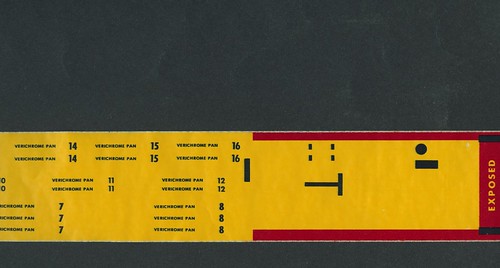
To this day, roll film is printed with backing paper that has a series of frame numbers on the back. This is what the backing paper from a roll of VP 620 looks like:


The numbers line up with a window in the back of the camera, and depending where that window is placed you get the frame alignments for square or rectangular pictures, whichever the camera is made for. On the above roll, for instance, you can get 16 square frames, 12 4x5 (I think?) frames, and 8 6x9 frames. The plastic windows that reveal these numbers can let in light even under the best of circumstances, and when the red plastic fades, as I think it did in the Bantam, you're pretty much shooting naked. Next time I'll remember to tape up the frame window, as I do with my Holgas and, pictured below, my moldy Brownie, about which I'll write more soon:

Anyway, I could only recognize one image on this roll of fogged film, and not coincidentally, it was one I shot on an overcast day, near dusk. It's the C&O canal in Georgetown:

In other vintage camera news, comedian, hero, American, Chris Elliott, in this clip from his late great Fox sitcom Get a Life, enters scene one with what appears to be a Brownie Holiday:


Later in the episode, a press gaggle hauls out their Speed Graphics. I don't have one of those, but I'll show you my Brownie Holiday later.


Saturday, March 19, 2011

photo book review: Takashi Yasumura, Domestic Scandals

I'm taking a brief detour from That Pile of Photo Books I Bought in January to bring you a preview of ANOTHER PILE OF PHOTO BOOKS I GOT LAST MONTH EBFORE SWEARING OFF BOOKS FOR A WHILE.

The Japanese are well known for their photo books - in fact there's an English-language coffee table volume dedicated just to Japanese photobooks of the 1960's and 1970's. Your big-city chain bookstore might carry this anthology, where you might also find the occasional monograph by Daido Moriyama, who I wrote about here, or Nobuyoshi Araki, but beyond those international stars the Japanese photo book can be hard to come by in the brick-and-mortar world. I bought this from Dashwood Books in New York. Article first published as Book Review: Domestic Scandals by Takashi Yasumura on Blogcritics.

This collection of thirty-six photographs opens with what is in effect a visual overture: an image of a plain carpet hard by a set of sliding doors decorated with a traditional bonsai tree pattern. If what follows is a succession of isolated objects of the modern world, the humor and elegance of the images speaks to the timelessness of the tradition in that first image: the minimalism and grace present in the bonsai sliding doors are given to the most humble things, from a stapler to a garden hose to a coffee pot, and curtains that should have been replaced so long ago that they’re hip now.

Domestic Scandals is perhaps a sensationalistic translation of the Japanese title of Takashi Yasumura’s dryly hilarious photobook. According to one of three writers who contribute essays to the book, the literal translation is the more modest and unjudgemental Everday-like-ness, and such is the unassuming world the photographer shows you in this wrly humorous book. Like William Eggleston, Yasumura finds striking images in the ordinary: a pair of bedroom slippers under a bed recalls a sloppier image in the classic photo book William Eggleston’s Guide.

Art is open to interpretation, and the photograph is no different, but the assembled essayists perhaps over-emphasize the politics of Yasumura’s work. His beautifully composed images of mundane objects like coat hooks and vacuum cleaners are explained variously as a critique of consumerist culture and as a scathing indictment of the fall of Japanese tradition. And sure, the juxtaposition of a salmon-colored plastic tape dispenser nearby a mass-produced traditional-themed Japanese wall paper may have political resonance. But what of the coat hook on 70’s-era wood panelling? The images were all taken in and around the artist’s own middle-class house, and his dry observations are acute and funny and reveal a garish beauty in the most mundane objects. A stack of toilet paper and a plastic rose on a tile floor may well reference dying arts of scroll work and flower arranging, but that doesn’t erase the fact that the toilet paper rolls and fake flower, for all their artificiiality, are arranged with great care by the artist’s hand. The materials may change but notions of color and balance in composition live on. Which makes it a traditional work after all.

Friday, March 18, 2011

every camera i own: the kodak beau brownie no. 2

The Kodak Beau Brownie was produced from 1930 to 1933, making this one of the older cameras in my collection. It came in a model 2 or 2A: the 2 uses 120 film, which is still produced today; the 2A takes the obsolete 116 format. Before film formats were standardized Kodak was all too keen to produce cameras that required their proprietary rolls. So a lot of old Kodak cameras require obsolete formats like 828, 620, 116, though intrepid camera hounds are known to re-spool available film formats to fit these antiquated cameras. Me, I just buy expired film on eBay - black and white stocks, particularly Verichrome Pan,  hold up fairly well even decades past their expiration date.

The Beau Brownie was offered in a variety of colors,  the most collectible being the rose and green varieties. See the range of colors, and the really keen original boxes - like little monochromatic Mondrians - here.  I have the more sedate burgundy and black model, which is no less stylish and rather more dignified than the rose or green variations that go for exponentially more than I paid for this.

It's a fixed lens and fixed-focus camera. The viewfinders - one each for portrait or landscape orientation -  are too clouded over to be of much use. You have the choice of two mid-range apertures, which can be selected by a  metal bar at the top of the box that can be pulled out or left in depending on your desired exposure. The shutter mechanism is unusual, though I don't know if that's because something's wrong with my camera. When you release the shutter, a spring loaded rig bounces out of the way to briefly reveal the aperture and through that expose the film. A spring loaded shutter is not in itself unusual but this one is the springiest and bounciest shutter release in my collection.

I loaded it with Fuji Acros and on a sunny day this 100 ASA film was exposed pretty much on the nose. I took the camera to the zoo:


I also brought my D700 with an 80-200 f2.8 lens (no VR) and shot a number of sharp, tightly-composed portraits of this pachyderm. But  this is how people made pictures at the zoo eighty years ago. A roll of 120 produces 8 6x9 exposures. If you look closely, you can see a red panda in this one.


A pair of ducks at the frog pond were eager and closer subjects, but the lens doesn't focus enough for an intimate portrait.


Thursday, March 17, 2011

pizzicato five mon amour

I was in a pretty bad place even before world news took a tragic turn, from horrifying tour bus accidents to the seemingly immeasurable toll in Japan - a crisis that is just beginning.  I'd like to send good thoughts over there and anywhere in need but do these really help? Japanese culture has come through for me in the past, so maybe it does. So in this time of sadness I won't dwell on the beautifully melancholy oeuvre of Yasujiro Ozo or the epic struggles of Akira Kurosawa (though the bleak final reels of his late masterpiece Ran strike an appropriate tone about now), but on Japanese pop.


I don't remember how I learned about Pizzicato Five, but I do remember that I sent a handful of blank tapes to somebody on the jpop listserv (thank you Ben List, wherever you are) and in return got some of what would become and still is my favorite music. I must have first heard Pizzicato Five around the time my mother died in 1994, and I've always credited them with helping me get through that time. This music has always confounded some of my friends, who see in it nothing but style and pastiche. And on paper, a track that combines soul horns, Lou-Reed inspired background girl singers and direct quotes from at least two Sly and the Family Stone records sounds like an exercise in post-modern mimicry. But unlike, say, the post-modern exercises of Jean-Luc Godard (whose visual style found it's way into a number of P5 videos), producer Keigo Oyamada lovingly forged out of Western pop influences a distinct aural magic - "A Supersonic Sound Spectacular," as they like to say. Sure, you can dance to it, and you will. I probably learned the English translation of the lyrics at some point but it doesn't matter - Nomiya Maki's vocals sell it completely, not just because her pipes deliver a credible Japanese soul, but because her soul has nothing to do with trying to sound like an American soul singer. The borrowed "baby"'s and "whoah-whoah"'s  seem not so much ridiculous as impossibly touching, a torch passed on from someone who has discovered their onomotapoeoic magic from afar and wants to preach the good word to a new land. Even now, almost twenty years after I first heard it, I find this song so beautiful it can move me to tears.

Addendum: um, while I love "Happy sad" too (part of its chorus gives me a chill), this is the song I was talking about above. I meant to end this post with it:


More addenda: Pizzicato Five broke up in 2001; Nomiya Maki and Yasuharu Konishi made solo records, and Konishi went on to produce other Japanese pop artists, but it was never the same. The producer of this record, Keigo Oyamada, made wonderful records of his own under the name Cornelius, in homage to Planet of the Apes. In fact, Oyamada is so dedicated to American culture that he and his wife, singer Takako Minekawa, named their son Milo, after Cornelius' son in Escape from the Planet of the Apes.

every camera I own: the kodak bantam, pt. 1: camera of the unknown and possibly english schoolboy

I bought a Kodak Bantam at the Antiques Garage in Chelsea last year, and have run half an eight-exposure roll of 828 Vericrhome Pan through it. I'll post those results soon, but first: there was a roll of exposed film in the camera when I bought it, and I just got those pictures back.

The camera was made in 1935. The Union Jack is prominently displayed among other unseen flags. So it could be England ... or a Commonwealth?


Looks very English school uniform - but was this necessarily taken in the same place the other photos were made?


The Bloggy Bloggy Dew accepts any and all identifying suggestions. I'm sorry the family who made these photos were never able to see the developed product. I wonder what happened to them and how their camera (in its original box!) made it across the pond - if indeed this is across the pond.

Friday, March 11, 2011

photo book review: Jason Fulford, The Mushroom Collector

Welcome to the next to the penultimate (or penultimate if I combine the remaining and eminently combinable volumes) episode of That Pile of Photobooks I Bought in January. Article first published as Book Review: The Mushroom Collector by Jason Fulford on Blogcritics.

Jason Fulford’s The Mushroom Collector was featured on a number of lists of the Best Photobooks of 2010, and was at the very top of photographer Alec Soth's top ten. But it was with some trepidation that I opened up this volume's collectible hide. (It's already going for more than twice what I paid for my copy just two months ago. It's not hoarding, it's investing.) Would it be worth the hype? Skepticism grew to awe and jealousy and then again awe aas I followed the elliptical and ingeniously subtle narrative. What kind of visual tissue sandwiches a mushroom collector’s picture postcard between photos of a shirtless hipster smiling from a refrigerator compartment (milk in the door beside him) and a rusted iron fence whose bars had been peeled away in some Incredible Hulkian feat of escape and/or rage? The best kind, that’s what kind.

This unusually structured yet completely logical book consists of the artist’s images alternated with a collection of mushroom trading cards a fellow photographer friend picked up at a flea market. Thus an unassuming collection of ephemera was the germ that infected this book, and there’s your metaphor. It’s a feature-length photo essay whose numbered photos are accompanied by the briefest of captions if any at all: “65. Locals had abandoned their birthnames after learning new ones,” is the simple but evocative text that frames the photo of a giant seashell emblazoned with the words “Class of 1971.” The strangeness of the natural world and the overlooked strangeness of the man-made world and their unexpected intersections grow out of these pages like a fungus indeed, spoors of inspiration carried in a breeze that takes you from here to an unknown there.

Fulford’s previous books have been keen design studies as well, and like Raising Frogs for $$$ (The Ice Plant, 2006) and Crushed (J&L Books, 2007) this latest tome is bound in a sturdy cover that recalls old library books. His eye is a descendent of the William Eggleston/John Gossage vision that finds the mysterious in the ordinary, but he takes his visual cues in directions his spiritual forefathers would have never dreamed of. This is one of the few photo books for which that you should be wary of spoiler alerts - the narrative, however obscure, will surprise you. The Soon Institute/Publishing House, distributed by D.A.P., have put together a monograph that is both challenging and highly entertaining. The project has also spawned a companion website with appendices that trace the book's progress from concept to proof to delicious final pudding.

Wednesday, March 09, 2011

every camera i own: the smena 8m

The Smena 8m doesn't get the Lomographic love that the company showers upon its line of overpriced Holgas and neverending series of limited edition Diana replicas (n.b., and if anybody's interested in the Meg White edition Diana kit, ping me). But this modest camera has a level of control not found in most plastic cameras: adjustable shutter speed (from B to 250) and aperture (from f4 to f16) in a 40mm lens. You even cock the shutter to snap a picture. It's not the most well-built picture-making machine ever made, but I'd sure trust it to rattle around my bag with impunity more than the flimsy Diana+. The trouble for me is the range focussing, which I'll have to get the hang of by the time I get through all my cameras, at least a few more of which will require me to guesstimate what's in focus.

I think it cost me ten bucks in the early 00's. When I pulled it out of one of the several plastic storage bins that hold many of my cameras, it was loaded with Elite Chrome that had expired more than ten years ago - the same stock that was in the PhotoBlaster, which if you'll recall turned out completely magenta. I'll have that roll processed later, but in meantime I re-loaded it with a roll of Kodak Gold 100 that had only expired in 2002. This held up much better. Though there's still the range-focus issue.


I shot most of a 24-exposure roll on a walk across the Williamsburg Bridge, which has a place in jazz lore as the place where tenor sax legend Sonny Rollins retreated - frustrated by where his music wasn't going - and where he practiced during his time away from the jazz scene in the late 50's and early 60's. The comeback album released when he returned to jazz was in fact called The Bridge. I wonder if he ever goes back there.


As often as I run away to New York this trip marked a couple of firsts for me - my first time walking the Williamsburg Bridge, and my first visit to the Village Vanguard, where so many jazz legends have performed: Rollins, John Coltrane, Bill Evans, just to name three who recorded landmark albums on the premises. The headliner last weekend was drummer Paul Motian, part of one of the great piano trios. And it was in that space fifty years ago that Motian joined  pianist Bill Evans and bassist Scott LaFaro to record one of my favorite jazz albums. I got a little misty eyed when it occurred to me that I was seeing Motian on the same stage where this was recorded:


Motian, who turns 80 at the end of March, is the last surviving member of that trio. Evans passed in 1980 at a relatively young age, having just turned 51. LaFaro, whose exquisite bass helps make the Village Vanguard sessions so achingly beautiful, died in a car crash ten days after recording this. He was 25.

Monday, March 07, 2011

welcome things readers

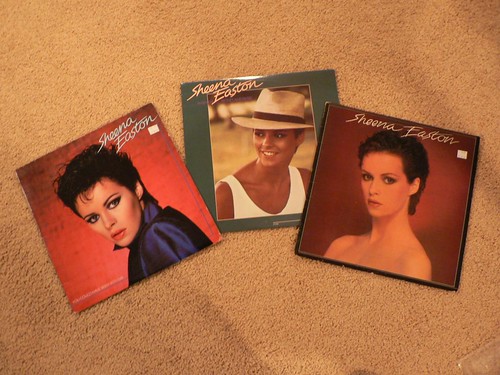
ahd bae tha' fr'a dollahHello to those of you who have found this blog via a link from a things magazine article on collectors, in which the subtitle of the present blog, "it's not hoarding, it's curating!" is taken as a symptom rather than a disease. Lately I've been documenting my camera collection and a recent haul of photo books, the latter of which I was in the process of reviewing in toto before succumbing to a fresh episode of binge-booking. But that's for another post. But those collections are well within the realm of the ordinary and respectable, if no less obsessive in their futile attempts to fill the void with eponymous things that can't hold you when you're feeling blue. And while what I am about to show you is no exception to the melancholy rule, what you should really see is my Sheena Easton collection (ed. note: which is perhaps not so much a collection as a loose gathering of a handful of related things), which I blog about here.

Thursday, March 03, 2011

every camera i own: the polaroid one 600

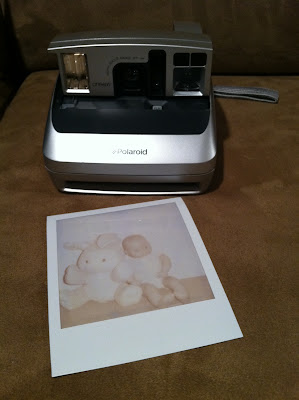
The plan this week was to post photos from a Smena, a plastic Russian camera manufactured by the people who brought you the Lomo. But I loaded it with expired slide film that I already know will be completely magenta, and I never even got around to taking it to the lab because the last time they sent some out it came back over a week later. But instead of showing you, oh, my iPhone 4 from Verizon (which is what I used to make the picture at left), here's a generic late-model Polaroid with a picture shot on film made by the Impossible Project, who resurrected (read: boutiquified it and charged more money for, but really, it's nice stuff) Polaroid film. This is one of their monochrome films,  PX Silver Shade. It's  rated at ASA 600,  and thus with the built-in flash and limited exposure control of the One600 camera, he image is more than a little washed out. I'm running away in the morning and may come back with freshly shot film. Or not.

photo book review: Antonio Caballero, Las Rutas de la Pasion

Article first published as Book Review: Antonio Caballero: Las Rutas De La Pasion Mexico, 1960s-1970s by Antonio Caballero on Blogcritics. Welcome to this week's installment in The Pile of PhotoBooks I Bought in January.

Antonio Caballero’s most famous image is of the Hollywood Babylon variety: at a press conference in Mexico in 1962, Marilyn Monroe stopped for the adoring press gaggle and inadvertently flashed (nsfw) Caballero, who was then a working photojournalist. Monroe died a few weeks later.

It’s the kind of anecdote that can define an artist, and the combination of lurid sensationalism and tragedy is an apt backdrop to the second career that makes up this book. Las Rutas de la Pasion was the name of just one of the publications for which Caballero photographed and directed fotonovelas, the serial melodramas that were the soap opera equivalent of comic books. Caballero worked on some five hundred stories in his fifteen years in the business. And like comic books, the fotonovela format is not well respected - a New Yorker review of a Caballero exhibition at Sikkema Jenkins & Co. in Chelsea dismissed it as ephemera, mere source material for what another critic called the more “conceptually rigorous” likes of Cindy Sherman. How sad that the search for conceptual rigor can blind one to the sartorial and narrative surprises of these photos.

Caballero also has an eye for the unuusal, not something you find in just any purveyor of  mass-market ephemera: what is that stuffed poodle doing in the picture of a married businesswoman on the telephone? And is the image of two women looking at their distorted faces in a fun-house mirror a commentary on how we view art? Perhaps the latter is just for entertainment, but such work is proof that a singular vision and personality can reveal itself in even the most commercial of sources. Caballero’s keen sense of composition and narrative sense makes these images more than ephemeral. And taken out of context, they gain a mystery that goes well beyond their pulp sources, and, in this critic’s estimation, more than the much-vaunted narcissistic rigor of Cindy Sherman herself.


The exhbibit at Sikkema Jenkins took isolated frames and enlarged the medium-format negatives to exhibition format, and was a tantalizing selection of just a fraction of his commercial work. The 2005 monograph presents a broader view of Caballero‘s work of this period, which includes ordinary pinups and the occasional dog-show shoot. Motifs abound: lovers meet clandestinely in a park, as is their wont in the melodramatic world of the fotonovela. But the variations on standard motifs can be startling: in one remarkable sequence, the lovers meet in an barren urban landscape of severe skycrapers that looks straight out of Michaelangelo Antonioni’s L’Avventura - and in fact was shot in 1960, the year Anontioni’s film was released. Coincidence? Las Rutas de la Pasion is not an easy volume to track down, but the photographs of Antonio Caballero (not to be confused with the work of a Columbian novelist of the same name) is well worth seeking out.

The hunt for more of this work sent me into the world of Mexican fotonovelas, which I've started posting on my Tumblr. I'm not sure if any of the fotonovelas I've purchased so far contain Caballero's photos, but I have found examples of some of the magazines he worked on. And I'd wondered how the images worked on cheap newsprint and with text boxes - and, apparently, generous airbrushing. I'll post more anon, but here's a preview, from a 1965 issue of Vidas de Secretarias.

Saturday, February 26, 2011

photo book review: Carmen Soth, The Brighton Bunny Boy

Photo courtesy of Little Brown Mushroom.
Here is this week's literally eleventh-hour (twenty-third hour if you keep military time) photo book review, brought to you by the pile of photo books I bought last month.

Last year Magnum photographer Alec Soth was commissioned to work for the Brighton Photo Biennial. But due to a last minute snaggle he was unable to get a work visa in time. At a loss to deliver what was asked of him, on the fly he enlisted his then seven-year old daughter Carmen to photograph what she saw in Brighton. This young woman has now produced two books based on that experience under the auspices of her father, and although in some ways less ambitious than Brighton Picture Hunt,  The Brighton Bunny Boy (Little Brown Mushroom), a collaboration among Carmen, Alec, and Gus Soth,  remarkably conveys both the innocence and anxiety of childhood.

Soth pere recently explained to the New York Times, for whom he occasionally blogs that there are wall photographers and there are book photographers, and he considered himself squarely in the company of the latter. I wouldn’t tell anybody not to see a Soth gallery show, but I would tell you to run and find one of his excellent books, from his landmark debut Sleeping by the Mississippi (of which I am fortunate to own the much-sought after first edition - and signed at that!) to the tabloid style newsprint edition The Last Days of W.

He has passed on his gift for the photography book to his daughter, who supplies the kind of openness and imagination that most of us unfortunately grow out of. The Brighton Bunny Boy incorporates Carmen Soth’s text and illustrations with her father's photos of an elusive boy (played by brother Gus) who mysteriously hides in a bunny costume. Such alienation is often seen in her father’s work but I all too well remember that childhood alienation, different from that of adulthood but no less acute, and Soth adresses one of the painful dilemmas of growing up: how to find and assert your identity in the greater society. In the span of eighteen zine-sized pages, a brief but not at all minor drama plays out with character development and resolution. The book is cute and unsettling, a winning combination. May the Soth family continue their monographic winning streak for generations to come.

Also recently reviewed: the new Criterion DVD editions of Sweet Smell of Success and Luchino Visconti's rarely seen Senso for Blogcritics. This post was brought to you by the letter S.

Update: The Seattle Post Intelligencer syndicates Blogcritics content, and Alec Soth just linked to the review from the Little Brown Mushroom blog with the clarification that Carmen took all the photos as well. Yay Carmen!

Thursday, February 24, 2011

every camera I own: the olympus pen f

This is the second Olympus Pen F I've owned, the first one having literally fallen apart after moderate use. Olympus resurrected the Pen series in name and compact spirit for their EP line of Digital SLRs, but the quasi-retro design of those new cameras, while not unappealing, pale in comparison to the keen contours of their inspiration.

The original Pen F series  were half-frame SLRs that made two photos - in portrait orientation - on one frame of 35mm film.(Pen EE and other models were less expensive, fixed-lens cameras.) More than a dozen lenses were produced in this particular mount, which is not compatible with the standard OM mount (though an adapter was available). The most sought after of these Pen-mount lenses is the 38mm f2.8  "pancake lens", named not for syrup and blueberries but for its even more compact design. You could buy a lot of short-stacks for what these lenses go for. The only lens I have for this camera is the 40mm f 1.4 pictured - but it's a sweet fast lens.

The double-capacity of the half-frame camera was used to sell this series as a means to conserve film, but I like it for the possible juxtapositions.

Tuesday, February 22, 2011

nanowrimo day 24: gluttony

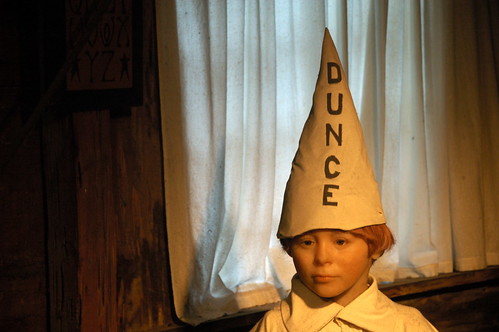
The character of Jimmy the Gent started as a stock Damon Runyonesque thug-cum-Lenny from Of Mice and Men foil, but he grew into a stand-in for authorial awkwardness. In this scene Jimmy the Gent (whose name I took from a James Cagney movie) appears at the family of Mmrma/Mortimer, who the careful reader may recall is the once jawless ventriloquist dummy sho took my nanowrimo work in a completely different direction from the art-world satire that I started out with. An except from the 1920-word output for November 24:
“Hey Morty, did ja really eat all those people like the lady dreamed, did ja huh?” inquired an inquisitve Gent.
Morty looked over at Crackers, Cheese, and Butter, the sisters all gathered there for the holiday feast. “Why, no, Jimmy,” Morty responded without additional hesitation or sweating of the brow that would indicate that he was hiding something or other to the contrary, Crackers and her sisters ain’t nevah eaten a juicy, tender New York strip of haberdasher marinated with Worcestershire sauce and brown sugah and vinegar --”
“--and gahlic! Lots and lotsa gahlic!” clarified Butter, smacking her lips at the Gent’s thick calf muscles peeking out from under his flood-length pants.

“Not dat I tink dere’s any ting wrong wif dat,” noted the Gent. “Azza mattera fack, I could maybe use somebody like dat in my manner of employment, if ya get my drift.”
Cheese slipped the Gent a card. “Well, and again, like I was sayin’ it’s not like we’re in that kinda business - at least not anymore,” clarified Cheese. “But if ya need a hand you could give us a buzz at that numbah. Anytime after 4,” Cheese whispered. “In the mornin’!“ The card read, in 14-point Gill Sans, [the following is one of my favorite lines in the whole 50,000 words I wrote]:
CHEESE
AVAILABLE FOR PARTIES
555-1212
Several bottles of wine later, The Gent, who up till then in his acquaintance with Morty had barely so much as raised an eyebrow in guffaughter, was dancing with Cheese and a lampshade on his head, in that order. "Put me down, ya big ape!" Cheese shrieked, afraid for her life and worried she'd have to be refinished. "Put me down! Ye'll wreck the wood grain! Put me down! Jimmy! Down! Down! Down! Jimmy! Down!"


"Da, have ya ever done da limbo rock, Cheesy? It’s all dey talk about on da islands, mon!"
"No I ain't nevuh done da limbo rock and I ain't about ta, now put me down right now Jimmy the Gent or oil moider ya!!" protested Cheese, as if to remind the Gent of that so-called dream.
"Aw, you wooden dames ain't no fun. And by that double negative, I mean that ye wooden dames are a lotta fun! Haw haw haw!" The Gent swung his head up and down like a heavy-metal singer with a screaming and hanging on for life ventriloquist dummy named Cheese in place of a curly blonde head-banging mane. This rhythmic semi-circular motion continued for several minutes, untill ... 

"Oh Jimmy, I tink I'm gonna be ill ..." Cheese warned tenderly, before her eyes rolled in the back of her head, her spring-loaded double-take mechanism jammed on repeat and the contents of her dinner [begin word-count padding exercise] (mushroom gravy, mashed potatoes, dark turkey meat, white turkey meat, turkey gizzards, turkey neck, a slice of ham, a slice of prime rib, a spoonful of green peas, a dollop of cranberry relish, two slices of home-made bread and store-bought unsalted butter, noodles au gratin, a slice of apple raisin pie with crumbly crust and a scoop of fudge ripple ice cream, a slice of pecan pie with toffee and chocolate chips and bourbon topped with low fat chocolate whipped cream, two glasses of red wine, and two hands full of Girl Scout salsa trail mix) [end word-count padding exercise] spewed projectorilly in a wide vibrating arc defined by the angle of the Gent's headbanging ambition of the moment and the aforementioned jammed spring-loaded double-take mechanism.
"Ah gee, Morty, sorry about dat," a chastened Gent begged pardon of his host as at the same time he delicately wiped a weary Cheese’s mouth and dinner dress. "Dah, it's no wonder I don't get invited ta parties too much. Ya okay dere hon?"
“Don’t ... call ... me ... bleaugh ...” an exhausted, and suddenly hungry, Cheese half-heartedly chided her awkward ride. 
"Don't worry about a ting, Gent," Morty reassured his buddy, although the steam pipes behind Crackers' ginger pig-tails began to percolate with impatience. [begin word-count padding exercise] "I was already gonna warsh dose curtains, and I had a mind ta hose down the winders, and it was on the toppa my ta-do list ta re-paper that wall over there on the uddah side a the room, and I was just gonna have a conservator look at that Turner etching, and you might see the post-it note to remind myself to polish the Giacometti walking man replica, and tomorrow’s my day ta pressure clean the stucco ceiling, and this weekend I was gonna have the parquet floors refinished, and it’s high time we had the Oriental rug steam-cleaned, and the predetermined hour approacheth for to give Junior, Segundo, Bottles and Tilda a sponge bath, and I gotta wash my hair ever night ya know, and I’d almsot forgotten to take my collection of Madagascar string-ties to the dry-cleaners, and my calendar tells me it’s the semi-annual day to re-bind my first edition of the complete works of Henry James, and bi-weekly bathe my collection of seventy-eight RPM records of Enrico Caruso in soap and distilled water, and after a big holiday supper we always re-fill the salt and pepper shakes in the life-sized shapes of Shields and Yarnell anyways - [end word-count padding exercise] so don't you worry about a ting, and make sure ta come fer Christmas. If ye ain't busy, dat is!"


"Aw gee, I'd be happy ta come fer Christmas!" The Gent was touched, a lot, and even more still, and wondered what he'd do for presents, not sure what was cool with the kids dese days. When he was a young tyke, he always wanted a Tonka car carrier, and dreamed he got it but never did get one. He never had a Big Wheel. He never had Rock 'em' Sock 'em Robots. But he had a tricycle, and then a bicycle, and then a unicycle, and then shoes, and always a roof over his head and warm food in his mouth and a wool blanket with cowboys lassoing cows on it, and he never wanted fer nuthin.

“I wunduh if Cheese’l be there. Aw, I hope she’s fuhgiven me for makin’ her trow up like dat an’ all. Say, I know what I’ll do - I’ll bake cookies - lotsa cookies! Dat’s hat I’ll do!” And that’s what Jimmy the Gent would do indeed, because his source for Hallwoeen Oreos out of season was none udder than himself, Jimmy the Gent, that is ("That's *me*," he directs his thumb at his barrel chest to reaffirm his identity as gentleman as well as to answer knock-knock jokes) possessed of an industrial-grade wafer mold procured from the since renovated Oreo plant in Walla Walla Washington, secret recipes wrested from Oreo chefs after minor administrations of troot serum and oil of eucalyptus, to relieve congestion and open up the nasal passages, and a team of elves to man the assembly line production and packaging of Oreos of any season.
But he'd make special cookies from scratch just for the kids. And fer Cheese, if she’d fergive him. And if Crackers would let him back inta the house. It was gonna be Christmas after all. 
...

Outside the American Yeast plant, Giuseppe D'Abbondanza wept and kneaded his yeaAst apron. "No! No! No!" he cried as he watched the unintentional conflagration of his life's work rise up like fluffy devils in the place of countless loaves of bread that would no longer be any good for sandwiches. "Mamma mia!"