Yesterday I found my copy of Ghostly Men, a small non-fiction book about the Collyer Brothers, the most famous of the old-time hoarders. It was right under my nose, or rather on a three-shelf case under the nose of a five-shelf case, most of whose latter's shelves are doubled-up with books. I knew it was here somewhere.
The hit reality show Hoarders, which appeared on basic cable just after I decided to do something about my pack-rat's environment, takes us into the homes of contemporary Collyers, and I'm relieved to say that the terrible conditions in which these capital-H Hoarders try to live don't look much like the crap I've accumulated over the years. But I still have decades of clutter to go through and have been steadily weeding and making discoveries (as fans of Sheena Easton may have already discovered) and clearing space and the soul.
This morning I took a shot at the attic - not the crawlspace as I've previously written about, but the main floor area. I only spent an hour up there but I filled a garbage bag of junk and also found school and other papers I'd like to hold onto, some of which I'd been looking for for a long time:
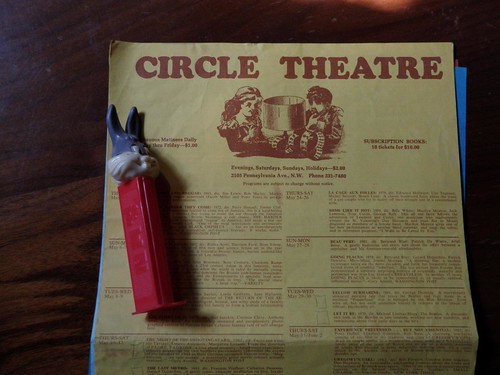
The Circle Theater was where I learned about the movies. I saw hundreds of filsm here when I was in high school, many of them one-dollar matinees. The most unusual double-bill was Fast Times at Ridgemont High paired with Merry Christmas, Mister Lawrence; I didn't much like either of them, but this was the place where I first saw some of my favorite movies; Badlands, Chinatown, North by Northwest. It was a run-down, vermin-infested theater but Washington, DC is a poorer place for its loss.
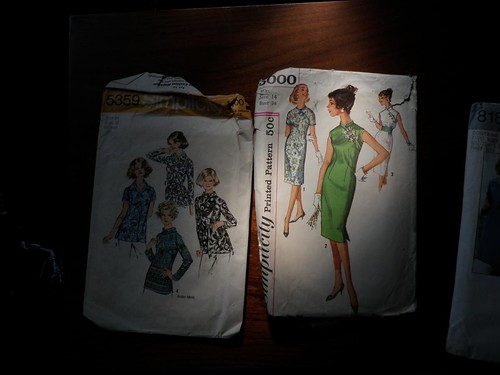
My late mother was a seamstress, and I've long wanted to see if the accoutrements of her trade were still stashed away in the house. I found old patterns in a bag that was again right under my nose.
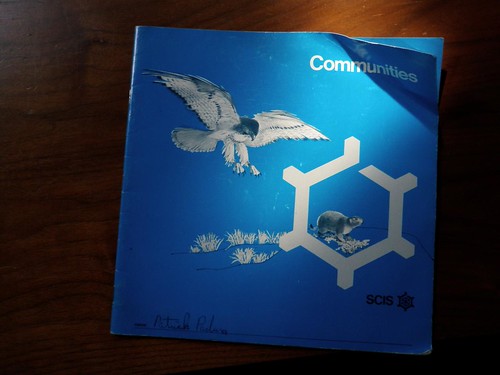
I found school papers and old drawings, more of which I'll post anon, but this most intrigued me, from a Social Studies folder. What an awful vision of community was presented to our young minds ca. 1977.
The six-pack of Coors belonged to one of my brothers and was acquired ca. 1972, when the brand was hard to come by in these parts.
Except for the beer, I'm not planning to throw any of these out. The struggle continues.
As a photographer, I'm always curious how other photographers work with models, whether they be friends or strangers. The tritely titled documentary People *LOVE* Photos (couldn't they have come up with anything else? The Naked Eye? A Thousand Words? Look At Me? ), directed by Christian Klinger, looks at three very different women photographers, and what struck me most are the very different ways they interact with their human subjects.
Tanyth Berkeley works in the Diane Arbus tradition of street photography. A street photographer has a number of choices to make in her quest for subjects: do you shoot inconspicuously, as Robert Frank and Walker Evans often did? Or do you interact with your subject, as Arbus did? Berkeley is not a gregarious speaker but her unassuming personality helps her interact with strangers, as we see in sequences that follow her on a photowalk in the streets of Manhattan. She dresses in a kind of New York photographer's camo, in dark hues and with only a single camera, but the spare arsenal is a way not to hide but to approach strangers with all her cards out.
Ashley MacLean and Traci Matlock (aka Rose and Olive) were discovered on the photo sharing/social networking site Flickr, of which I am a member. They are extroverts with a capital E, as also suits one of their specialties — erotica. I don't know if it's just coincidence or if it's a result of their personalities, but their interview segments are the best sounding parts of this documentary. No attempt was made to mix down ambient noise in other segments, and in some scenes, particularly those on the streets of Manhattan, this is very distracting.
The sub-heading of this segment is "Sexuality," and at one point I started to get the feeling that the director was exploiting models in a way that the photographers didn't. It's one thing to photograph the female form in the nude; it's another to show the photographers spraying down a model's breasts with a water bottle. But when the artists start feeding each other raw eggs while topless, you realize that letting it all hang out is just part of the their work. Sexuality is not always portrayed in comforting ways — bloody and bruised bodies are not unexpected sights in their work.
Elinor Carucci is probably the best known of the photographers shown here; her monographs have been published by Steidl and Chronicle, two of the major art-book imprints, and her work has appeared in the New York Times Magazine, among other publications. Her work seems to be the most personal of these artists, and the most intimate: Carucci's subject is her family. She examines her relationships with herself and her blood kin in a way that combines the family surveys of Sally Mann with the diaristic and sometimes sensationalistic work of Nan Goldin. Throughout the simple nudes, even those of her C-section scars after giving birth to twins, are about her relationships. A photo of her crying, snot-nosed child has apparently upset some viewers but Carucci feels it's simply an ordinary shot of childhood.
The original score to the documentary is a circular piano figure that sounds unresolved. The music lends a dramatic tension that does not at all suit the proceedings. The music reminds me of the tinkling Ligeti piece featured in Kubrick's Eyes Wide Shut, and that alone should tell you how inappropriate it is for a documentary about photographers who go about their work with eyes wide open.
One of the marks of a good photographer is the ability to edit. Robert Frank shots hundreds of rolls of film for the project that became his iconic book The Americans. People *Love* Photos is only 97 minutes but, though no fault of the subjects, seems much longer.
("I will lift up mine eyes unto the hills from which cometh my strength" --Psalm 121:1)
There may not be in all of earth A region totally without lure, Without a modicum of worth. If man but labor and endure; But living at its thrilling best Is yours in such a land as this Which nature lavishly has blessed With ocean's tang and sun's gold kiss Upon the dark and loamy soil That folds the gift of seeds away And by some swift and secret toil, Brings forth their yield in sweet array.
Come down, ye seekers for a land Of wondrous favor, bright with peace, Where quickened heart and mind and hand Reap harvests of untold increase! The shining pines await you here, And wooded hills are redolent With pungent fragrance all the year; When miles before you have been spent And you have reached your journey's end, You'll find delight indigenous, And every citizen a friend To welcome you as one of us.
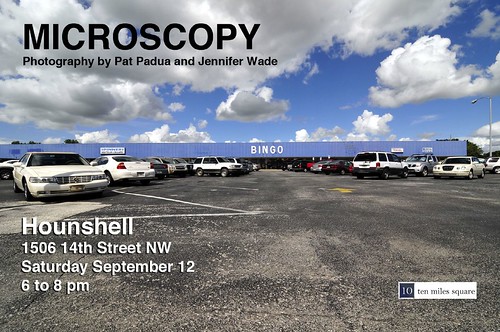
Join Ten Miles Square and the work of Pat Padua and Jennifer Wade in Microscopy at Hounshell (1506 14th Street NW) this Saturday from 6 to 8 p.m.
Padua and Wade take a closer look, literally and figuratively, at the minutiae of life. Padua's photographs feature the quirky side of Americana that constantly seesaws between the oddly humorous and vaguely depressing -- images like a shiny, bright red gumball machine encouraging us to enjoy hugs (and not drugs!), left to rot full of decaying, colorless candies, or a wide-shot of a packed bingo hall parking lot on a gorgeous day. Padua takes his microscope to a modern society that seems to have little interest in (or perhaps knowledge of) any world that exists outside the frame. Heavily influenced by Martin Parr, these images also document our strange relationships with consumerism and collectibles -- Jesus and Mary figurines suffocate silently in plastic wrap waiting for the true believer to save them.
Jennifer Wade takes a more literal approach to her Microscopy. A scientist by trade, she uses a scanning electron microscope to turn every day items into the soaring patterns of mountains and sheer cliffs of a cracked ring, swirls of atoms on chunk of coral, or the rushing current of fibers on a cut piece of paper. Much like Padua's photos, they remind the viewer that it's possible to both lean closer and step way back, and encourage the viewers to find their own perspectives.
Hounshell is at 1506 14th Street. Head down Saturday night to also enjoy openings at Irvine Contemporary, Hemphill, Gallery Plan B, the Hamiltonian Gallery. Many thanks to the Pink Line Project for helping make Microscopy possible.
I had the day off monday. I usually spend it running errands, maybe getting drunken fried rice for lunch and seeing the latest Adam Sandler movie - and, more often than not, shedding a tear at its sentimental resolution. (The only Adam Sandler I saw that *didn't* make me cry was REIGN O'ER ME, the post-9/11 stress syndrome picture which was slathered in Very Important Resolution and seemed far less emotionally convincing than LITTLE NICKY). But this monday I spent the day off weeding, and perhaps apropos of Sandler, I went back to my childhood.
I don't much like the language of twelve-step programs, but to be honest, living in a big house enables the shit out of me. My present and past acquisitions are scattered to the far corners of three floors and an attic, and part of the task of weeding is clearing out one space in my room only to bring in something I've left elsewhere in the house, more or less negating the space gained upstairs. It's like the world's least inefficient conveyor belt with no chocolate shop at the end in which to sell my irregular samplers. I can work for an hour or two and know I've made a quantitative difference, but then take a look at the resultant space and see hardly any aesthetic difference at all.
It goes both ways. Last month, in the early stages of my weeding renaissance, I dragged a copy-paper box full of old New Yorkers out of my room and took it up to the attic. The most recent issue in the box was late summer 2001, and the issues went back to the mid-90's. That I didn't just empty the box outright has been gnawing at me, and I pictured its contents, sitting on an old cocktail table in the attic, crashing through the floor and sending decades of clutter and pithy columnists all the way down through to the basement.
So I went up to the attic with that simple goal in mind - to bundle up the spawn of David Remnick and mercilessly drop them in the recycle bin. (If you open up the recycle bin right now, you'd see Gore Vidal's sour puss, advertising whatever it is they advertise on the back of a 1990's New Yorker, peering back at you through the twine. Don't let him sway you, he means no good.) And I did just that, but not before taking a detour into the crawlspace.
I don't remember the last time anyone went up into the crawlspace, but if you calculate years by the number of seconds it takes for the rattle of dust and dirt to pour out of the corners of the crawlspace door and trickle down the attic stairs and finally come to a stop; clearly it had been decades. Another temporal indication would be the 70's-era shopping bag from Woodward and Lothrop department store, which had closed in 1995. The bag contained parochial school papers I'd long forgotten, and if I had remembered them I'd assumed they were thrown out long ago. The cavemen photos, from the Smithsonian Museum of Natrual History, are most likely the first photos I ever made, for a school project on Neanderthal Man. I think they were taken with a Kodak Instamatic 110. Not bad. Although I'd grow into photographic influences like William Eggleston and Martin Parr, in these photos I see a budding Nan Goldin.
On the back of this drawing (the stains under the title at the top of the page are fresh sweat), I wrote "Eleventh Station [of the cross]," which is the Crucifixion. But I'm not sure even the advanced abstractions of what must have been my seventh-grade mind would have made the leap from crucifixion to a puppy caste system. It's not unlike an Adam Sandler movie.
I've been weeding. I'll weed maybe a handful of books or CDs at a time, and with as much clutter as I've accumulated over the years that barely makes a dent. Because, despite what it says under my blog header, I hoard. Not on the Collyer level but I missed that by a matter of degrees, and I was perhaps only saved from that fate by a major termite infestation that required sorting out and throwing out 40 years of basement clutter.
Still, I buy books I never read and CDs and lps I never listen to and movies I never watch. I end up buying duplicates. With no discernible organizational system, I'm not surprised to find two copies of a book I've never read. What surprised me was the CDs. Despite having at least 80% of my thousands of CDs in alphabetical and categorical order, I still found five inadvertent duplicates - which doesn't count remasters of CDs I found filed right next to their original, arguably inferior but perhaps more valuable for sentimental reasons iteration. (n.b., If anyone reading this would like a sealed copy of the compilation CD, "Brazil Samba Jazz Vol II," with the Tamba Trio's terrific version of "Se voce se pensa," let me know.)
I hoard to fill the void, and I found absolute proof of that last weekend when I discovered, in the back of my closet, a bunch of empty boxes of various sizes, shoe boxes and shipping boxes that I thought I might need some day. Some of them must have been in my closet for more than a decade, and had accumulated several inches of dust. I took those metaphors to the recycling bin right away and I can walk in my closet now.
I've been weeding regularly, and I've made progress, and discoveries.
As I weed I come across things I forgot I had. One is a VHS tape of Sheena Easton's Act One special, one of dozens of tapes I scrounged from a video store's $2 closing sale several years ago. The program was originally broadcast on NBC in 1983 and captures a moment in the Scottish singer's career between the girl-next-MOR success of "Morning Train" and the tarted up persona of "Strut" and "Sugar Walls" (number 2 on the PMRC's "Filthy 15," right behind her collaborator Prince Rogers Nelson's "Darling Nikki.")
Act One is a strange piece of celebrity self-consciousness, with Easton trying on a variety of 80's fashions and identities only to fail to hide behind any of them. Maybe it's all that 80's make up, a Bonny lass hidden under a very pretty cakeface. She is not one of those performers who disappears behind her roles. Rather, Act One reveals that for Ms. Easton, as for many of us, as many disguises we try to hide behind, who we are will unmistakably shine through the cake.
Speaking of clutter, I happen to have a copy of Chambers's Scots Dictionary at my desk. Did you know that gardy-moggans are what they call long sleeves?
The first number "A song for you" serves as an overture of the major themes we will be exploring in the next hour; most strikingly, that of a Whitmanesque multiplicity and a personality in fragments (or shallmillens, as her people call them). Easton comes into focus from a black silhouette of her head against a stark white backdrop (apt echoes of Bergman's Persona). A soft-focus head shot dissolves into Ms. Easton leaning against some kind of prop box, mirrored on the other side of the box by her animus, or anima, or some androgynous harlequin mixture of both. Not that I'm suggesting anything.
As the overture comes to a close, the camera closes in on Ms. Easton pouting for the camera and attempting to look soulful and amorous underneath the volumes of 80's makeup; then she breaks out of character and asks somebody in the booth "is tha' akae?" Looking for approval. Over the studio intercom an unseen techinician tells her there was a glitch and they'll have to make some adjustments before they can continue with the production.
Ms. Easton then wanders through NBC back-stages killing time when she happens upon The Tonight Show set. A tarp is draped over the guest chairs but Johnny Carson's desk is open. Sheena takes Carson's chair and sets up the framing device for the rest of Act One, where she imagines herself a talk-show host. She interviews herself, surveying her career from the relatively subtle makeup of "Morning train" to today (then, 1983), never imagining the makeup she has in store. She also invites guest stars, including Al Jarreau and, naturally, Kenny Rogers, who joins her in a duet of "We've got tonight" in which you are forced to imagine that Ms. Easton would romp (rommie, v. to rumble, to beat. to stir violently) in the hay with that grey-haired beast simply because he's there.
It's when Ms. Easton takes her seat at Johnny Carson's chair that Act One begins to remind one of Werner Herzong's Grizzly Man. The documentary shows copious footage of the video Timothy Treadwell made in the wilderness as he tried to live with bears, but despite the magnificent natural backdrops and the danger we knew was coming, his tone struck me as that of a child putting on a private show in their bedroom. Ms. Easton put on that show for us in what indeed was only the first act of her career. It's a keeper.
Alain Resnais' Last Year in Marienbad is one of the most infamous works of avant-garde cinema. It polarized audiences in its day, when audiences still cared enough to be polarized about an art film. Pauline Kael lamented the "creeping marienbadism" of modern cinema, and given subsequent art-film indulgences you can't really blame her. But is the movie any good? Mariendbad has been unavailable on DVD for years, but thanks to a stunning new transfer from Criterion, a new generation can make up their minds about what did or did not happen last year.
The plot, such as it is, may be little more than high-class melodrama: X (Albertazzi), meets A (Seyrig), at a party and insists he's met her before. The dialogue appears vague and impenetrable: the opening narration is nothing more than a catalogue of a decadent hotel's super-baroque details. But pure cinema takes you through it, literally, as the camera dollies along baroque corridors and follows a shot that may consist of nothing more than two nattily dressed Frenchmen spouting some kind of avant-garde boilerplate ("it was '28 ... or '29"). This subverts conventional narrative, of course, but it's also a celebration of cinema — Resnais and his crew demonstrate that you (if you are a genius surrounded by beautiful people and impeccable craftsmen) Resnais and his crew demonstrate that you can take any old dialogue - say, Alain Robbe-Grillet's - dress and light it and come up with something compelling. Like The Sound and the Fury, you may not know what's happening, but the confident style carries you along - and you will follow that aesthetic anywhere. What is often lost in the controversy about Marienbad and what it means or doesn't mean is that this is simply one of the most beautiful examples of filmmaking ever struck to celluloid. Sacha Vierney's lush black-and-white photography; the handsome pair of Delphine Seyrig and Giorgio Albertazzi; even the man who can't be beat at matchsticks, Sacha Pitoeff, has an otherworldly creepiness that's beautiful; he's no less than the French Timothy Carey. If the film can be taken as an scathing indictment of haut-bourgeoisie values, then it certainly does not eschew beauty, but revels and dreams in it.
Resnais previous and subsequent films were often directly engaged in politics: the Night and Fog of concentration camps, a love affair tinged with politics in Hiroshima mon Amour. But in Marienbad, Resnais puts the real world aside to build something that only seldom is achieved in art: a perfectly imagined, self-contained world. It's a world that's best experienced in full immersion, in a dark theater on a huge screen; but in the absence of that, Criterion's release is essential viewing.
The bonus disc includes two early Resnais documentaries, Toute la mémoire du monde (1956), whose tracking shots through vast libraries prefigure Marienbad's camera gymnastics; and Le chant du styrène (1958). Also on board is a half-hour documentary featuring interviews with surviving members of the production team. They were Young Turks working on this production, Resnais included, but their dedication to the project - even though the script mystified many of the participants - were crucial to this masterpiece. In fact, it is through the meticulous craftsmanship that the film is actually less convoluted than it's making. To take one example, a scene where X and A are followed down a long corridor turns out to be assembled from shots of three different corridors. The script girl (Sylvette Baudrot, who still works with Resnais today) helped bring scenes shot months apart into a seamless flow, taking a gesture that Delphine Seyrig makes to turn away in one shot, continue into the second shot, filmed a month later.
The above youtube clips came over the transom from different sources the other day. I linked them one after the other on the Facebook and in jest remarked that "The line that connects Guss Visser to Cage and Cunningham is the line from which springs all subsequent American Art." By which I meant the blurring of highbrow and lowbrow upon which I base much of the creative work I do. Sans highbrow, perhaps. Moments later, I discovered, via Jeffrey Cudlin, the twelve-tone kitten work of Cory Arcangel, which proves my thesis in undeniably cuddly fashion. Here is the fruit of the lineage of Visser, Cage and Cunningham:
Last night I was given a polysomnogram to see if I had sleep apnea. I've never slept particularly well (insert Proustian episode here, with, in place of a madeleine, perhaps the frosted cupcakes I used to get at Reeves Bakery downtown when as a child I went shopping with my mother). The rooms in the Sleep Lab were equipped with the latest advances in sleep-inducing technology, including a peaceful television channel that reminded me of the scene in Soylent Green where Edward G. Robinson goes gently into that good night:
In the days leading up to the test I consulted with several friends who were veteran polysomnogramniacs, and their litany of inconveniences ranged from a telephone ringing down the hall to test patients in the next room reacting badly and vocally to the unfamiliar surroundings. The biggest worry I took from this was the paste used to affix sensors to the hair and scalp. I was assured by all that I'd find traces of this stuff in my naturally curly hair for days:
But owing to a recent change in formula, or the silken sheen of my naturally curly hair, or both, the gel washed off with no apparent residue. Still, it was an uncomfortable night, and the thick hospital walls meant I couldn't get a cellphone signal and was unable to live tweet the proceedings. But it went alright, and sometimes this week I will reward myself with a cupcake - if not the remembered cupcake of my youth, something from the aptly named Baked and Wired.
I watch old movies all the time and never ruminate on how many members of the cast of, say, The Magnificent Ambersons is still alive (zero major cast members, apparently.) But old tv clips like this make me sad. I wonder how many people who used to fall asleep watching the late show are today no longer waking up. Maybe it's that much of the cast of The Magnificent Ambersons is still remembered today. But who will long remember the names of these unidentified newscasters? Maybe it's the imperfectly preserved broadcast, the degrading video a reminder of what will happen to our memory and the memory of us. Will future generations have such a frisson when looking at the "early" days of the internets, the blogosphere, the twitterverse?
When we passed through Lake Wales last fall we were taken by the Hotel Grand, formerly the Dixie Walesbit, an unoccupied ten-story structure in the middle of town. I made a few phone calls and the next time we passed through with permission to enter the premises. Many thanks to the City of Lake Wales, who owns the property, for their time and generosity in allowing us a look inside.
The hotel was built in 1926, near the end of what is known as the Great Florida Boom. Though the Boom passed, the hotel remained open until the 90's, and passed through a series of commercial owners before the City of Lake Wales took over. Sadly, previous owners didn't know what to do with the place - during our one-hour tour we saw that many original details had been ripped out, and at least one floor had been subject to vandals - though it wasn't always clear if the vandals were destructive teens or destructive "renovators." The hotel is now slated for multi-use development. After talking with city officials and the developer we were heartened to hear how much they care about the history of the old place and hope to restore it to as close as they can get to its old glory.
Note: When in Lake Wales, get the garlic bites at Norby's Steakhouse. You'll be glad you did!
This latest installment in a series of Cryptozoological Hits of the Seventies is, save for the lurid sleeve design, uninspiring product. Can any band of supposedly comic artistes be worth their salt as improvisors if they can't think of anything better to call their group than "The Improvisors"? The B-side is a Christmas record, and while they certainly deserved their share of Christmas pudding I'm certain nobody slipped a Muse in their stockings.
By request: more cryptozoological hits from the 70's, this one from across the pond. The trick ending is a metaphor for the monster itself. Finally, who is the monster? We are the monster. Leave it to a handful of folk-rocking Europeans to ask the tough questions about life in the loch.
Director Chris Marker is best known for his masterpiece La Jetee, a 22-minute film consisting almost entirely of still images. This meditation on time and memory, which inspired Terry Gilliam's Twelve Monkeys, is one of the very few fiction films in Marker's vast oeuvre. (Less known is the music video he directed for Electronic's "Getting Away With It," which pays homage to La Jetee in its brooding remembrance of things past).
Marker's primary work has been in the documentary genre - but not the documentary as practiced by Ken Burns or even Errol Morris. Rather, Marker is a film essayist. Where La Jetee masterfully edited and juxtaposed the elements of still photographs to fashion a chilling science fiction, his documentary work, at its best, works such magic on the historical and cultural detritus of celluloid. His Sans Soleil (available on an essential Criterion DVD with La Jetee) is the pinnacle of this form, with layers of image and narrative that transcend the ordinary documentary to create a multi-faceted dreamscape of fact.
There may not be a more thorough document of the international student uprisings of 1968 than Marker's A Grin Without a Cat (aka Le Fond de L'air est Rouge). The director/essayist weaves a celluloid tapestry juxtaposing footage of explosives instruction with a television ad where an elderly couple boasts, "Now we're a TWO-set family." Copious tinted stock footage of army training films, pilot's-eye footage of a napalm attack on a village in Vietnam, and of course Eisenstein's The Battleship Potemkin battle for semiotic significance. But the talking heads (which include the likes of Che Guevara and Fidel Castro, natch) and onslaught of revolutionaries fail to incite the fervor of this non-student of the revolution. For the large part (Grin originally ran at what Marker himself admits was a megalomaniacal four hours) the released print is merely three hours) the film lacks the cross-disciplinary layering that makes Sans Soleil so fascinating. While essential classroom viewing, A Grin Without A Cat probably won't interest many outside the academy. But for those who were there in 1968, there's probably plenty of fodder for both sides of the political spectrum.
Inquiring Nuns sounds like a good concept for a half-hour television special: set two young nuns loose on the streets of Chicago asking passersby, "Are you happy?" The problem is that despite the seeming cross-section of the 1968 Chicago zeitgeist - both the hippies and the straight-laced, the religious and the non-believers - there's something about two young nuns asking "Are you happy" that prevents the interviewee from saying anything truly interesting. The respondents who the sisters speak to outside church - fresh after Sunday mass, even - are particularly polite and predictable. Which is too bad, because most of the people they speak to look interesting—you wonder what did the blue-collar worker, the businessman, the African-American grandmother, really think about what was going on in 1968? Many responded that they would be happier if America pulled out of Vietnam but that is all they have to say on the matter.
An occasional score by Philip Glass lends some minor chords to the proceedings but that's the extent of the tension onscreen. More interesting is the bonus material. Interviews with the nuns today reveal that both of them left the order, inspired by the times and each other to question authority (but not their faith) and pave a path that certainly contained more drama than the two television episodes on this DVD.
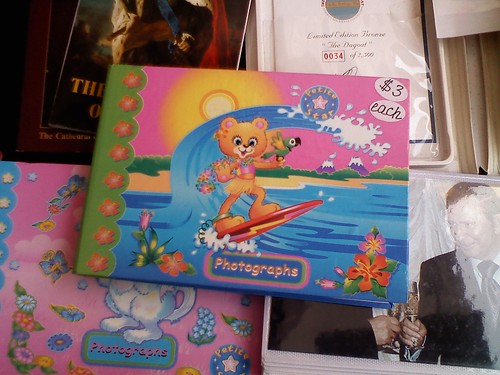
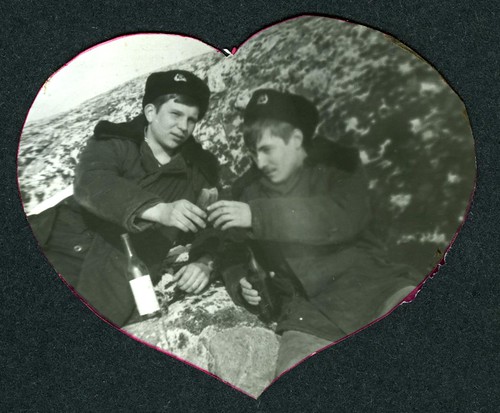
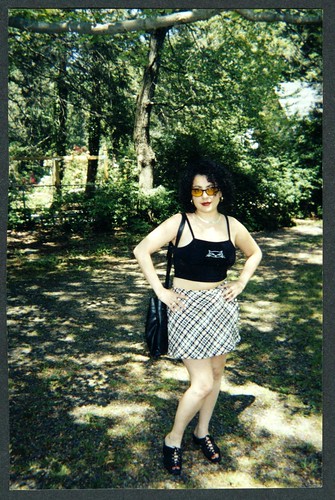
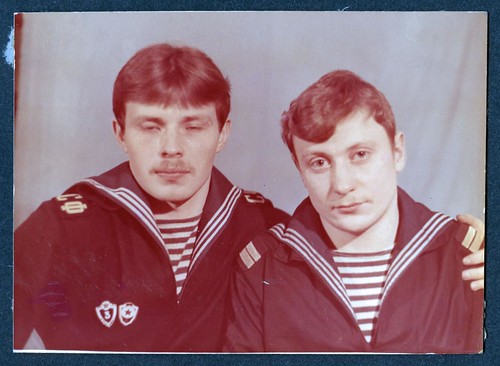
Ever since the bulk of outdoor flea markets in Chelsea moved to Hell's Kitchen, I've restricted most of my browsing to the Antiques Garage. I've ignored the few smaller markets left in the neighborhood, assuming they were closer in spirit to the kind of flea market whose specialties get no more obscure than knock-off designer purses and cheap socks and bootleg dvds. But I was wrong. One day this spring I stopped at one of those weekend parking lot markets that I normally pass by. I found the usual ratio of wheat and chaff but also some genuine antiques action. I was lured into one booth by a plastic photo album that depicted a surfing teddy bear. When I opened up that talismatic plastic ersatz Hawaiiana I was rewarded with a small but remarkable stash of Russian portraits and snapshots. Comrades of all inclinations as well as mail-order bride shoppers will find plenty here to whet the apetite:
The fabulous Veronica Ebert, aka lapinfille, is showing two of her pieces in this show curated by artist and art critic Lenny Campello: Frida Kahlo inspired show opens
The Joan Hisaoka Healing Arts Gallery at Smith Farm Center in Washington, DC will be hosting Finding Beauty In A Broken World: In the Spirit of Frida Kahlo. This exhibition showcases the work in all mediums of artists selected by me and whose work is influenced not only by Kahlo’s art, but also by her biography, her thoughts, and her writing or any other aspect in the life and presence of this powerful artist.
Frida Kahlo's artistic footprint in 21st century artists from all over.
This is the third Kahlo show that I have juried in the last decade and I am floored by the range of work and interpretations that I selected.
Reese Witherspoon and Paul Rudd were shooting a filum in town a few weeks ago, and they kept following me, first to the 18th and Columbia Rd. Starbucks. The next day they ambushed me while the 36 bus was caught in traffic on 15th street. Luckily, the bus sped me away unharmed.
[I promise not to blog about Michael Jackson this week anymore. - ed.]
The art and design world's response to Michael Jackson's passing has been fast and furious – and in some cases prescient. Within days, sidewalk vendors in major cities were peddling King of Pop memorial t-shirts, some of them festooned with variations on Shepard Fairey's ubiquitous red, white, and blue Obama design, the caption HOPE sadly replaced with POP but not yet, as far as this reporter has seen, the plainly accurate DEAD.
As for the prescience, the Leo Kesting Gallery in the Meatpacking District was hosting an exhibition of paintings by artist Jonny Fenix when the King of Pop suddenly shuffled off. The gallery quickly erected an impromptu memorial, showcasing Fenix's work, "Michael's Jacksons", priced to sell at only $3,000. I shot a photograph of this display on fast, grainy film that had expired in the 1990's, imagining that the color cast would reveal something about the fickle finger of fame and the half-life of celebrity. As it turns out, the colors were fairly accurate. Chalk one up to enduring legends or, rather, to refrigeration as metaphor and preservation technique.
Gallery director David Kesting, who opened his space in 2003 as a showcase for "cutting-edge" artists, writes that "Fenix's visual library references the characteristics Americans love while subtly pushing us towards resolution of the negligent hypocrisy we are now becoming aware of." Among the other subtle canvasses decking these Meatpacking District walls are a hairy disembodied penis and a black Jesus flipping the viewer double-barreled fingers. Fenix knows how to get your attention, and his at times tabloid subject matter is presented with a keen design sense.
The exhibit closed on July 5th but its memory may linger in the hearts of pop-culture students and jaded gallery crawlers, while the rest of us will revel in the harder-earned but still morbid laughter evoked by the James Ensor show at MOMA.
"I just don't believe that Michael would want me to share my grief with millions of others. How I feel is between us. Not a public event." --Dame Elizabeth Taylor to her 80,000 followers on Twitter, explaining why she turned down a request to speak at the Staples Center memorial.
I don't think there's a *wrong* way to express personal grief. I've seen my share of hospital waiting rooms and funeral homes, and people deal with things the best they can, whether they gnash their teeth or find distraction or simply withdraw. The death of Michael Jackson is a huge media event, but it has also provided an outlet, and for many people a public outlet, for all the ways we grieve. Missing the music and lamenting its decline, missing the child-man and denouncing the man-child, remembering where you were when you first heard "Ben" or "Billie Jean." Whatever you thought of him as a musician or a human being, his work and life is a nearly universal cultural reference, and everyone has an opinion about it - none more so than the celebrity griever.
I come here not to praise the common man but to bury the celebrity. Celebrity remembrances of Jackson or of any dead star can be as much a celebration of the person talking about it as of the deceased - often more so. When Kurt Cobain died in 1994, "Voice of a generation" Douglas Coupland pulled off on the side of the road near Candlestick Park in San Francisco to figure out how he felt about it - and made sure to tell that that to a major newspaper:
"I felt that I had never asked you to make me care about you," Coupland wrote. "But it happened - against the hype, against the odds - and now you are in my imagination forever. And I figure you're in heaven, too. But how, exactly, does it help you now , to know that you . . . were once adored?"
That hand-wringing tenor could just as easily have been texted or twittered on June 25th, 2009, when the level of teeth-gnashing was directly proportionate to the publicity machine of the mourner. A sample from Salon.com's roundup:
Celine Dion: “I am shocked. I am overwhelmed by this tragedy. Michael Jackson has been an idol for me all my life.”
Madonna: "I can't stop crying over the sad news. . . I have always admired Michael Jackson…The world has lost one of the greats, but his music will live on forever! My heart goes out to his three children and other members of his family. . . God bless."
Mariah Carey: "I am heartbroken. My prayers go out to the Jackson family, and my heart goes out to his children. Let us remember him for his unparalleled contribution to the world of music, his generosity of spirit in his quest to heal the world, and the joy he brought to his millions of devoted fans throughout the world. I feel blessed to have performed with him several times and to call him my friend. No artist will ever take his place. His star will shine forever."
But the winner of the celebrity mourner's Highest Achievement in Lack of Self-awareness Award goes to the embattled widow and shoe collector Imelda Marcos. If you know anything about her rise and fall, it's hilarious:
Imelda Marcos: “Michael Jackson enriched our lives, made us happy...The accusations, the persecution caused him so much financial and mental anguish. He was vindicated in court, but the battle took his life. There is probably a lesson here for all of us.”
I hope and imagine that somewhere in the swampland there's a saturday night Opry teeming with cryptozoologically-obsessed singer-songwriters of the calibre of Tom T. Hall, writing not simply about Bigfoot as Other but Bigfoot as I. Sadly, this ain't it.



 Ashley MacLean and Traci Matlock (aka Rose and Olive) were discovered on the photo sharing/social networking site Flickr, of which I am a member. They are extroverts with a capital E, as also suits one of their specialties — erotica. I don't know if it's just coincidence or if it's a result of their personalities, but their interview segments are the best sounding parts of this documentary. No attempt was made to mix down ambient noise in other segments, and in some scenes, particularly those on the streets of Manhattan, this is very distracting.